Years of warnings, delays preceded Edmonton road collapse
 Zoe MasonUpdated 1 day Ago4 Mins read
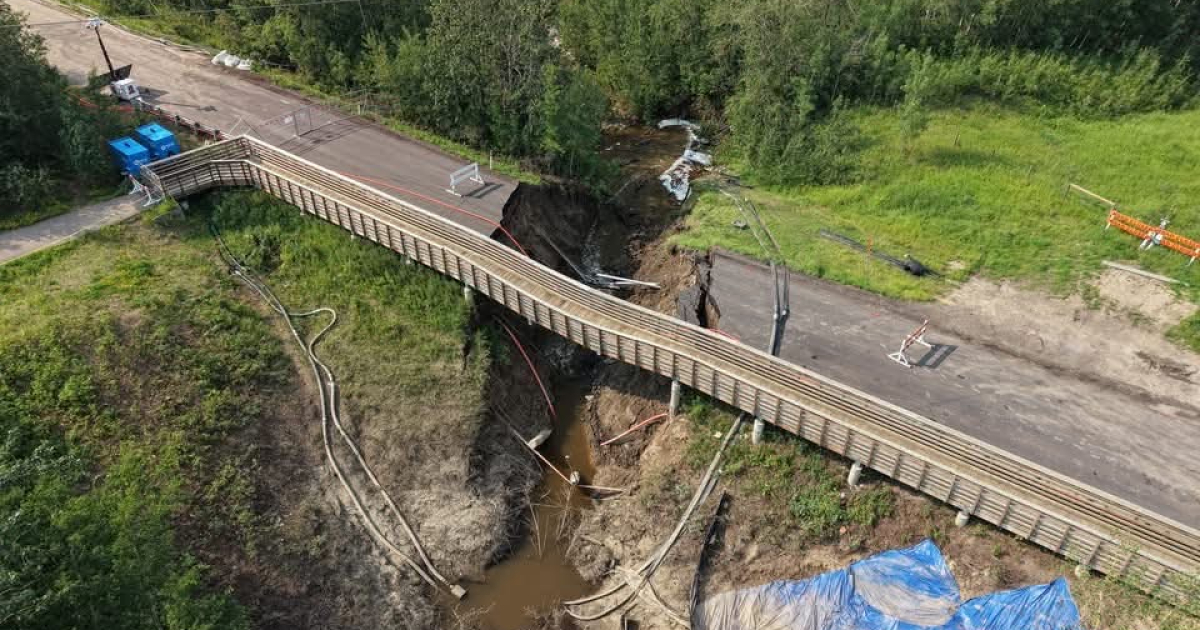
Starling resident Raf Tenderenda first noticed the erosion under 137th Avenue in 2023.
Tucked in the northwest corner of Edmonton, the neighbourhood of Starling shares borders with the City of St. Albert and the provincially-managed Lois Hole Centennial Provincial Park.
The culvert that’s supposed to carry Horseshoe Creek under the road was undersized and, as a result, the surrounding structure was showing signs of wear from the water. Tenderenda, a drainage engineer with the experience to know what would come next, raised the alarm.
He sent an email to his then-councillor, Andrew Knack, highlighting his concern. Knack raised it with EPCOR, the city-owned utility company. EPCOR said it was aware that the culvert under the roadway was undersized but had no timeline on plans to replace it.
After Tenderenda’s 2023 complaint, questions were bounced between the City of Edmonton, the provincial government and EPCOR. Upgrades were announced, then tied to projects with unspecified timelines, then postponed indefinitely.
In June, Edmonton was subject to a record-breaking deluge of summer rain that opened sinkholes across the city. At Horseshoe Creek, heavy rain carved out a gorge, and just as Tenderenda had feared, 137th Avenue fell in.
“Horseshoe Creek is just one isolated incident,” said Tenderenda in an interview with Canada’s National Observer. “But it also paints a bigger picture about transparency and risk management.”
The result is an infrastructure failure that is expensive, inconvenient and possibly environmentally damaging.

Scrapped plans for a fix
EPCOR has acknowledged it should have acted sooner to prevent the problem.
In a statement to Canada’s National Observer, EPCOR says a substantial investment into a new culvert at 137th Avenue was planned in 2024 that would have extended its lifespan by 30 years. But it later learned the city planned to abandon 137th Avenue and build a new arterial road, so the plan was scrapped.
In the meantime, EPCOR said it ramped up routine monitoring and post-storm inspections. But the city’s ambitious road realignment never moved ahead and the planned upgrades were never installed.
“It was a risk that we took on our part,” said Frank Mannarino, EPCOR’s water services business unit leader, at a meeting of Edmonton’s utility committee last week.
“We knew the road needed to be replaced; we knew that we didn’t have complete control over that project; we knew that the culvert was undersized. We weren’t expecting the very high level of rain, and that unfortunately led to some very unfortunate outcomes for that community.”
Mannarino dismissed the concept of an investigation into the failure when it was raised by a councillor.
“I don’t think there’s a lot of value in a review, because I don’t think that we would ultimately make a different decision.”
Shifting responsibility
Mayor Knack said the provincial government also played a role in halting the progress of a reconstruction effort, pausing the project indefinitely to allow for the production of a broader plan for Lois Hole Centennial Provincial Park.
The Ministry of Forestry and Parks told Canada’s National Observer that a management plan for the park was produced in 2019. A spokesperson said they were unaware of any further plans for the area.
As for the road realignment, the ministry said discussions are ongoing about the future of that project, and the city is in the process of filing applications for the two provincial authorizations required.
EPCOR took responsibility for the city’s drainage utility in 2017. However, with the scale of work now required to restore roadway access across Horseshoe Creek, responsibility has been transferred back to the city effective Aug. 31. The infrastructure required now is classified as “bridge sized.”
Construction on the road is slated to begin this week. The work, which includes rebuilding the roadway, installing a new larger culvert and stabilizing the creek’s slopes, should take nine weeks to complete.
Neither EPCOR nor the city were able to provide cost estimates to Canada’s National Observer. Prior to the washout, EPCOR had pegged the price of the culvert replacement at $2.7 million.
Numbers kept from the public
The terms of the EPCOR takeover included a commitment to maintaining transparency under the city’s open data initiative.
Before 2017, the City of Edmonton maintained a public database featuring several key performance indicators, including kilometres of sewers cleaned and number of catchbasins cleared.
Since, the city-owned corporation has stopped updating those metrics.
When Tenderenda requested the records associated with inspections, maintenance and risk assessment, he was told he’d need to pay a fee of $6,237 to access them.
Last week, the City of Edmonton utility committee passed a motion requesting a memo from EPCOR about its commitments to providing drainage data.
City planning documents for the area identify Horseshoe Creek and the adjoining Big Lake as a valuable ecological corridor and habitat for wildlife and vegetation.
Tony Druett, a board member of the Big Lake Environment Support Society, told Canada’s National Observer he is concerned about the debris from the roadway that was washed into the creek, as well as the impact of the construction required to replace it on the nearby provincial park.
Federal Minister of Environment Julie Dabrusin said in a letter that her department is aware of the washout and will determine the appropriate follow-up, which may include an inspection to verify compliance with federal regulations.
Tenderenda, also the president of the Big Lake Community League, says residents are concerned about the effect on access, which has an impact on everything from morning commutes to emergency response times.
“It’s frustrating because I feel like this could have been prevented. It also makes me think about how many other culverts, sewers and trunk lines are not in great shape, and Edmontonians don’t know,” he said. “You will not see the failure the next day or next month. It could be years.”


Canada unveils more sign-based retaliation against the U.S.
A sign on display during a B.C. Premier David Eby news conference...
Afternoon front page: The importance of teaching Canadian history; is Trump escalating the trade war?; and more
Wounded Canadians take cover behind a pillbox during the Battle of Passchendaele...

Cannabis-smoking Ontario stabber gets day passes despite ‘significant threat’
Article contentGhawar had been treated by a psychiatrist for anxiety and depression...
AI minister says solutions exist after Anthropic researcher quits over safety fears
The federal artificial intelligence minister said the government is closely following the...