A Chinese Battery Plant Moved Into This Illinois Town on State Money. Its Residents Can’t Vote It Out.
 Sean TsengUpdated 5 hours Ago14 Mins read
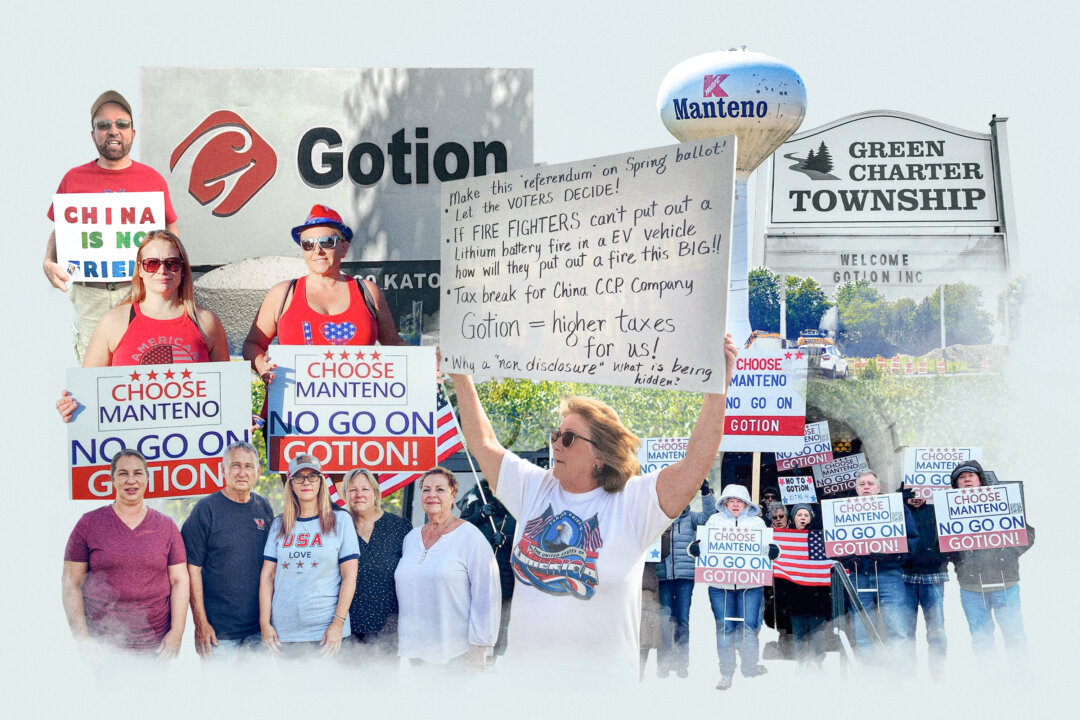
The empty Kmart distribution center on the edge of Manteno, Illinois, used to pay about $900,000 a year in property taxes. Then Gotion, a Chinese battery company, moved in, and the local officials who welcomed it capped the company’s property taxes at $2 million a year for 30 years—no matter how much it builds inside.
Most of that money goes to the schools, because that is how Illinois splits property taxes. The fire district’s share, for taking on a two-million-square-foot lithium battery plant, comes to about $140,000 more a year.
“Well, it’s not going to work,” said Mike Barry, a village trustee who lives a quarter mile from the plant. The town also sits in an enterprise zone, he told The Epoch Times, so it “waived all their permit fees and inspection fees and everything else.”
What that fire district may one day have to answer is the kind of fire that, once it takes hold, usually cannot be put out, said Michael Pecht, a distinguished professor at the University of Maryland who directs its Center for Advanced Life Cycle Engineering and is regularly called on to investigate why batteries catch fire.
Water cools the cells for a few minutes, he told The Epoch Times, but a lithium battery makes its own oxygen and keeps burning, and a fire that looks dead can flare back up a week or two later.
Faced with a chemical fire like this, he said, “the fire department can’t do anything.” The best course is the one fire departments now urge on one another: “cordon off the area, make sure that there’s nobody inside, and just let it burn.”

Gotion is not an ordinary tenant. Its Chinese parent’s corporate charter set up a Chinese Communist Party (CCP) committee inside the company, called for the board chairman to serve “in principle” as the Party secretary, and let CCP members move onto the board and into senior management. The parent’s 2022 corporate responsibility report, reviewed by The Epoch Times, counted 923 CCP members and 11 Party branches. Its largest single shareholder, though, is currently Volkswagen’s China arm.
Illinois announced the project as the largest electric-vehicle battery investment in state history and has paid Gotion $165 million in cash. Almost no one else has embraced it: Michigan declared the company in default on a separate project and is trying to claw back roughly $24 million; Congress barred the Pentagon from buying its batteries; and federal tax law cut it off from the tax credits that most American battery plants rely on to make money.
Residents, trustees and outside analysts keep coming back to three things: the plant deepens American reliance on Chinese-made batteries rather than reducing it; the deal was assembled under a nondisclosure agreement that kept the company’s name from the public for more than a year; and the people who object have no legal way to remove the officials who said yes.


(Left) Illinois Gov. J.B. Pritzker (Center R) and Gotion representatives announce plans for a lithium battery plant in Manteno, Ill., in Sept. 8, 2023. (Right) The headquarters of Gotion, Inc., in Fremont, Calif., on Aug. 26, 2026. Courtesy of Gov. J.B. Pritzker’s office, Dylan Morgan/The Epoch Times
‘Project Unity’
Manteno did not choose Gotion. It found out about it.
The hunt for a site ran through the Illinois Department of Commerce and Economic Opportunity and a private site consultant, under a nondisclosure agreement the county’s economic development group joined in September 2022—more than a year before the deal was announced. An official from that group later testified that the agreement never named the company. Even the group’s own slide presentation laying out the tax break, which residents pried loose through records requests, never says “Gotion.” The document is titled, instead, “Project Unity.”
Governor J.B. Pritzker announced the deal at a signing ceremony in September 2023. By then Amanda Piker, a Manteno nurse, had already started filing records requests, after asking on the village Facebook page who Gotion was and getting no clear answer.

Those records showed the village had spent public money to hire a Chicago public relations firm as the Gotion decision moved through town hall. To Piker, it looked like something worse: “One of the biggest eye-openers was our FOIA request where we figured out that they were paying a PR firm to do opposition research on us,” she said—residents who had been asking questions about the deal.
The payments, she said, came in pieces of about $20,000—each too small to force its own line-item vote.
The emails show the firm trading messaging and website answers with the village administrator in late November 2023, with the mayor at the time copied in—the days between the plan commission’s recommendation and the board’s final approval.

Local resident Amanda Piker in Manteno, Ill., on Sept. 3, 2026. By the time Illinois Gov. J.B. Pritzker announced the Gotion battery plant deal, Piker had already started filing records requests after asking about Gotion on the local Facebook page and getting no clear answer. Nathaniel Smith for The Epoch Times
What Michigan Did

Robby Dube, attorney for Concerned Citizens of Manteno, in this file photo. Courtesy of Robby Dube
Gotion’s first American site was in Green Charter Township, Michigan, and the residents there stopped it before it could break ground—not in court, but at the ballot box. They recalled the township board, then officials in a neighboring township, then county commissioners, until no one was left in office who would approve anything for the Chinese company.
Then something strange happened. Gotion sued the township in March 2024, won a preliminary injunction that cleared its way—and still never applied to build.
“All they had to do was actually apply for the permit, start breaking ground on this plant that they supposedly said they wanted—and they did nothing,” said Robby Dube, the attorney for Concerned Citizens of Manteno, the residents’ group suing to stop the plant in Illinois.
That is the behavior behind Dube’s leading theory about what Gotion is doing in Illinois, though he is careful to say he cannot prove it. A company can chase one of two things, he said.
“One is to just hit the milestones, get the money from the government, and if the project falls apart, oh well,” he said. “There’s a certain minimal level of activity you can do to get the money.”
“Two is, if they can thread the needle and actually get this thing into operation, then they can be one of the suppliers of batteries for data centers, which are going through a big boom right now.”
Michigan has sued Gotion to get its money back, since no milestones were met. Illinois has not.


(Top) Manteno residents opposed to a Gotion battery plant demonstrate outside the Kankakee County Courthouse in Kankakee, Ill., on Jan. 14, 2025. (Bottom Left) A sign states “Welcome Gotion Inc” in Green Charter Township, Mich., in this file photo. Residents successfully stopped the Chinese battery maker from building a plant in the rural community. (Bottom Right) An overhead sign signifies downtown Manteno, Ill., on Sept. 3, 2026. Courtesy of Amanda Piker, Courtesy of Jim Chapman, Nathaniel Smith for The Epoch Times
No Way to Recall
Manteno’s residents cannot do what Michigan’s did, and most of them do not learn that until they go looking.
The Illinois Constitution lets voters recall exactly one official: the governor, a power that voters added to the state constitution in 2010. It says nothing about mayors, village trustees, or county board members. A town can write its own recall rule, and almost none have.
The lack of a recall option leaves the town cornered, said Lori Brock, whose Michigan farm sits across from the abandoned Gotion site there and who has advised the Manteno group for two years. “For one, they can’t recall anybody,” she said. “There’s laws against it in their state, so they have no real way to fight this.”
There was also a simpler difference. Gotion never broke ground in Michigan, but in Manteno, it moved into a building already standing—so the fight began with the company already inside. “They really need Illinois to work,” said Jillian Rojas, a board member of the Manteno residents’ group, “because they no longer have the Michigan option.”

Concerned Citizens of Manteno board member Jillian Rojas in Manteno, Ill., on Sept. 3, 2026. “They really need Illinois to work, because they no longer have the Michigan option,” Rojas said about battery maker Gotion, Inc. Nathaniel Smith for The Epoch Times
More Dependence on China, Not Less

Michael Pecht, professor and electronics expert, in this file photo. Courtesy of Michael Pecht
The batteries arrive finished. Gotion said so in writing in September 2024, when its representative, Russell “Cole” Sayre, told the village that “Phase 1 is only assembly” and that “the batteries are already manufactured, tested & sealed prior to reaching our facility.”
That distinction is the whole point. A battery cell—the sealed unit that actually stores the power—is the hard thing to make, Pecht said: the work of “gigantic companies” with clean rooms and enormous scale. A battery pack is just a bundle of finished cells fitted into a frame and wired together. The cells come from China; workers in Manteno set them in frames and put the covers on.
Asked whether that lessens American dependence on Chinese batteries, Pecht said it does the reverse. “No. It means more dependence on China’s supply,” he said. “It’s the reverse of what one thinks.” Making cells takes that kind of scale to turn a profit; snapping finished cells into packs takes none of it. Assembly, he said, is “the very low end.”
Which raises the question the plant’s neighbors keep asking: why do low-end assembly in Illinois at all, against this much local opposition? Part of the answer is the state money on the table. Part may be trade, Pecht suggested—assembling on U.S. soil could sidestep the steep tariffs Washington has placed on finished Chinese batteries.

Streetlamp banners honor hometown heroes in Manteno, Ill., on Sept. 3, 2026. Nathaniel Smith for The Epoch Times
Gotion never hid the order. At the 2023 hearing, its senior production manager told the village plan commission that the first phase would be storage containers, the second would be packs built from cells “already made, already tested” in China, and only the third would be an actual cell factory.
The state sold the third phase. The building has been running the first—the low-end assembly that deepens the reliance on China the plant was meant to reduce, and never reaches the cell factory that was the point.

State grant records point the same way. The equipment those grants have paid for, itemized in Gotion’s own spending reports to the state, went to module, pack and energy-storage assembly lines—not cell-making machinery—even though the state’s approved plan for the site called for it to “produce 10GWh Pack + 20GWh Cells by the end of 2025,” a deadline that has now passed.
Asked directly whether its agreement requires Gotion to manufacture cells in Illinois rather than assemble imported ones, the Illinois Department of Commerce and Economic Opportunity did not say it did. “Assembly is part of manufacturing,” an official told The Epoch Times, and such a project “can be assembly only if that is in the approved application.”

The headquarters of Gotion, Inc., in Fremont, Calif., on Aug. 26, 2026. The company is a subsidiary of Chinese battery maker Gotion High-Tech. Dylan Morgan/The Epoch Times
A Million a Year
Because a battery fire is not an ordinary fire, a plant like this is expected to keep its own trained firefighters on site rather than lean on the local department. Manteno wrote that into the deal: Gotion would field a brigade and keep six of them on the floor at all times.
The company did not want to. For most of a year, records show, it pushed back—and at one point offered to solve the problem with a check instead. Rather than staff the brigade the town wanted, an executive wrote to the fire chief in June, Gotion would pay “up to $1 million per year” for outside fire coverage—“$15 Million over 15 years”—if the district would cover the plant with three responders a shift rather than six. The chief said no. A payment, the district wrote back, does not put trained people on the floor when a battery starts to burn; it just leaves the town’s crews holding a risk they were never equipped for.
The question stopped being hypothetical on a June afternoon, when a battery pack caught fire on a production line. By the account in the fire district’s own report, it went about as well as it could have. The plant was evacuating when the first officer arrived, and Gotion’s brigade—in full gear and air masks—had already knocked the fire down, dropped the damaged pack into a tank of water, and hauled it outside. No one was hurt. The brigade worked.
It also showed what the town has taken on. The district’s report put the cause as electrical and referred it to a fire investigator. And even with the flames out, the danger was not over: because a lithium battery can reignite hours after it looks dead, the ruined pack had to be watched overnight. That job fell to the plant’s own experts—“there were Chinese engineers here that would monitor it overnight,” the company’s safety manager told the responding officer. This is the hazard the fire district took on for its extra $140,000 a year.

A sign warns visitors at the gate of the Gotion battery plant in Manteno, Ill., in the summer of 2025. The plant was declared a foreign trade zone, allowing Gotion to manufacture lithium battery packs and systems with reduced customs costs and operational flexibility. Courtesy of Julie Holda
The Paper Trail
Blocked from voting the deal out, the residents did the other thing open to them: they sued. But the law met them with a hard limit at the courthouse door.
They could not win simply by pointing to who owns the plant, said Albert Lin, a professor of environmental law at the UC Davis School of Law: “I am not aware of a case where the mere fact of ownership would demonstrate nuisance.” What can make ownership matter, he told The Epoch Times, is a record of the owner “running sloppy operations.”
In Manteno, that record was sitting in the village’s own files, and it went back to the day the plant opened.
The town let Gotion move in on Aug. 22, 2024, after the company signed a letter promising to fix seven fire-safety items that were not yet fixed—among them ventilation units locked out, an emergency voice-evacuation system not yet installed, and leaking valves. One was the outdoor fitting where firefighters connect their hoses to feed the sprinklers; someone had written beside it that it “will not open.” The repairs were due eight days later. The town handed over the occupancy permit that same day anyway, all of it still unfixed.


(Top Left) Activists Jillian Rojas, Amanda Piker, and a fellow community member hold signs during a protest walk in Manteno, Ill., on Oct. 22, 2023. (Top Right) Activist Ann Gates protests outside the battery plant location in Manteno. Ill., on Sept. 8, 2023—the day Illinois Gov. J.B. Prizker announced the project. (Bottom Left) Darrel Bruck, founder of a Kankakee County group that opposes the Gotion battery plant, holds a sign at a protest and press conference outside Manteno Village Hall in Manteno, Ill., on Oct. 2, 2023. (Bottom Right) Manteno residents hold signs voicing opposition to the Gotion battery plant, in this file photo. Courtesy of Amanda Piker, Courtesy of Concerned Citizens of Manteno
The next morning, the fire chief put his distance from the town’s decision in writing: his sign-off, he noted, was “not a final comprehensive list, nor is it an approval for the final occupancy permit.”
The lawsuit itself came down to one question: does the plant use the kind of highly toxic chemicals Manteno’s code forbids? While the residents were in court arguing that it would, a village official quietly wrote the opposite into the occupancy permit—an official finding that the plant uses no such chemicals. No one told the residents, even though it settled the very point they were suing over.
The village then used that finding to seek dismissal, arguing the residents’ group had never formally challenged that finding. The judge refused. A town cannot bury a decision and then blame people for not fighting it, Judge Lindsay Parkhurst wrote: the defendants “cannot use administrative remedies as both a sword and a shield.”

(L–R) Concerned Citizens of Manteno members Amanda Piker, Robert Forsythe, Jillian Rojas, Julie Holda, and Fran Ludwig, in Manteno, Ill, on Sept. 3, 2026. Nathaniel Smith for The Epoch Times
Washington’s Answer
Washington’s answer to Gotion came in the form of law—twice.
Two years ago, Congress singled Gotion out by name. The National Defense Authorization Act for fiscal 2024—the annual law that sets Pentagon policy—bars the military from buying batteries made by six Chinese manufacturers, Gotion among them, starting in 2027.
Around the same time, an Illinois congressman, Darin LaHood, joined a Michigan colleague on a bill aimed squarely at the company: the No Official Giveaways Of Taxpayers’ Income to Oppressive Nations Act, or NO GOTION Act, meant to keep federal money away from firms like it.
The standalone bill never got a vote. But its core idea was folded into the sweeping tax-and-spending law President Donald Trump signed in July 2025, the One Big Beautiful Bill Act, which used that same defense list to strip companies like Gotion of the federal credits that make most American battery plants profitable.

Rep. Darin LaHood (R-Ill.), chairman of the House Ways and Means Work & Welfare Subcommittee, asks a question during a hearing on Capitol Hill in Washington on Sept. 1, 2026. In November 2023, LaHood co-sponsored a bill—dubbed the “NO GOTION Act”—to block U.S. green energy tax credits from going to companies linked to adversarial nations. Mariam Zuhaib/AP Photo
Who Gets the Bill
For all that Washington has done, the checks in Illinois kept clearing.

The state made Gotion the first recipient of a new investment fund and, records show, sent the biggest single payment—$125 million—weeks before the village board had even voted to approve the plant. Two more grants followed. The last is the one that sticks: comptroller records show the state paid Gotion $27.5 million on Dec. 30, 2025—about six weeks after the fire district had put in writing that Gotion’s safety commitments to it were still unmet. In January, a Gotion official told the village board the matters were resolved.
Asked whether the company is keeping its promises, the Illinois Department of Commerce and Economic Opportunity, which wrote the checks, gave a careful answer.
“Gotion is in compliance with their reporting,” a department official told The Epoch Times—a statement about paperwork arriving, not about jobs or investment. The agency has acknowledged it holds no records certifying Gotion has hit the targets the money is tied to. The deal promised 2,600 jobs. The plant has a few hundred.


(Top) Members of the Illinois Freedom Caucus and other supporters of Concerned Citizens of Manteno at a press conference outside city hall in Manteno, Ill., on Oct. 2, 2023. (Bottom) Members of Concerned Citizens of Manteno meet author and China analyst Gordon Chang (4th from R) at a fundraiser for the group in Olympia Fields, Ill., on Oct. 28, 2025. Courtesy of Amanda Piker
That is backwards from how these deals are supposed to run, said Kristan Wong Karinen, a research analyst at Good Jobs First, a Washington group that tracks state and local subsidies. The protection for taxpayers, she told The Epoch Times, is to pay only “after the terms of the agreement are met.”
The plant is not without its defenders. The schools collect more than they did when the building sat empty. The building trades unions signed on early and testified for the project, and its jobs are required to pay above the county’s average wage.

A win for the residents would also be narrower than it sounds. It would bar the battery operation, Dube said, but not empty the building or cost the town its tax base—another tenant could simply take the space. “If someone else wants to come in and be a Costco, or be a warehouse for Mattress Firm or something,” he said, “all that’s allowed.”
What the town cannot get back is the order in which it all happened. The approvals came first, then the plant, and the safety checks and the firefighters have been catching up ever since. Barry, the trustee who started with the arithmetic, is blunt about who is left holding it.
“Now we’re the ones that are sitting here trying to pick up the pieces of decisions that were made by our ex-administration and our governor,” he said.

A water tower in Manteno, Ill., on Sept. 3, 2026. A battery plant operated by Gotion, Inc., occupies a former Kmart warehouse in Manteno. Nathaniel Smith for The Epoch Times
The Epoch Times sought comment from Gotion; its U.S. counsel, Polsinelli; the Village of Manteno; the village attorney, Joseph Cainkar; and B&F Construction Code Services, the firm that handled the village’s plan reviews. None responded by publication time. The Illinois Department of Commerce and Economic Opportunity answered questions for this article, and both it and the Manteno Community Fire Protection District released records under the state’s open-records law.
This report draws on certified transcripts of the Manteno plan commission hearings; filings and rulings in Concerned Citizens of Manteno v. Village of Manteno (No. 2023-CH-37); records obtained from the village, the fire district, and state agencies under the Illinois Freedom of Information Act, including Gotion’s REV grant agreements and the state’s disbursement records; Gotion’s corporate disclosures and permit filings; Illinois Comptroller payment records; and interviews. (I have all the supporting documentation on file, and can provide upon request.)







Chinese Woman Admits to Gathering Intelligence in US for Beijing: FBI
A Chinese woman stopped at Detroit Metropolitan Airport has been charged after...

Dozens Detained as Tibetans Protest Xi Jinping’s Visit to India
Chinese leader Xi Jinping’s motorcade arrives at Bharat Mandapam in New Delhi...

China Audits Farmland Use, Hits Businesses With New Fees Ahead of 2027 Law
Businesses and property owners in parts of China are facing new charges...

Nasdaq, S&P 500 Open Lower on Calls for AI Slowdown
A selloff in key artificial intelligence (AI) stocks weighed on the leading...