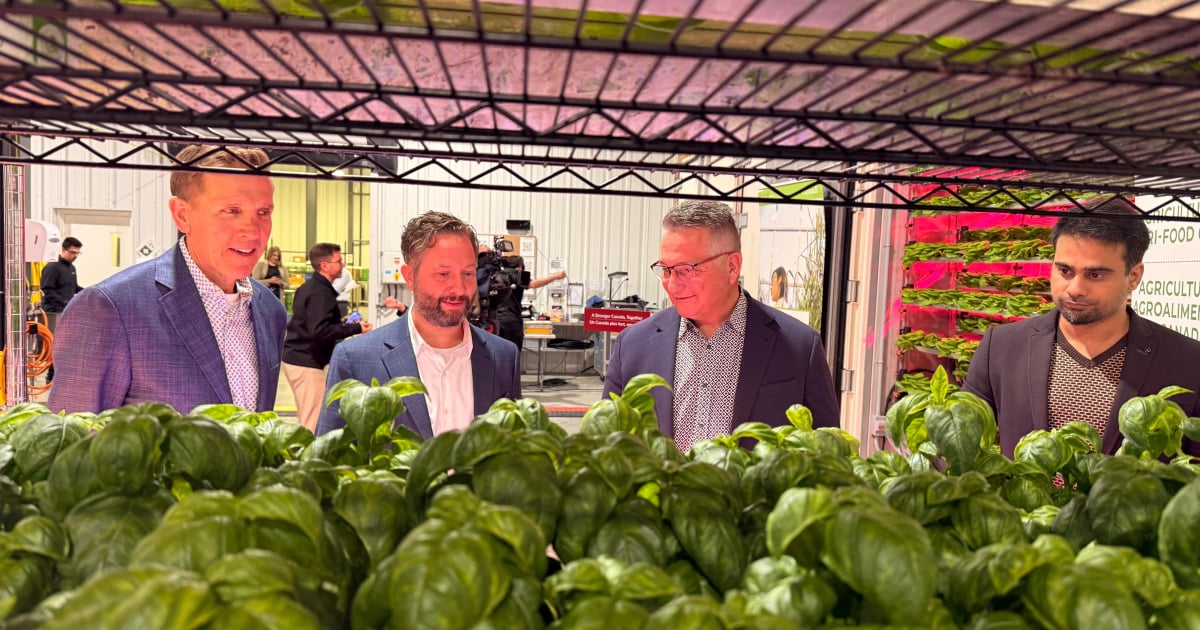
A Calgary ag-tech company is preparing to test its lighting system at four commercial farms to see whether rapid LED pulses can help farmers grow the same amount of food using less electricity, and federal funding is supporting the trials.
Indoor farms rely on artificial light to replace the sunlight plants would normally need to grow. Most greenhouse fixtures stay on continuously, but Jared Wolfe, CEO of SmartGRO Bioengineering Inc, said their system works differently: it switches LED lights on and off in bursts too fast for people to detect.
He said the pulses are designed to match the frequency at which plants absorb light, with the goal of using less electricity to produce the same harvest.
“The plant talks to the light and the light responds to that,” Wolfe said.
Earlier controlled tests produced the same harvest weight under SmartGRO’s lights as under regular LED lights, while using up to 80 per cent less electricity.
The company recently received nearly $900,000 in federal funding through the Agricultural Clean Technology Program’s research and innovation stream, which is administered by Agriculture and Agri-food Canada. The money will help move the company’s lighting system into Alberta and Ontario, where it will be tested under real greenhouse conditions.
Wolfe said the funding is part of a broader program worth about $7.5 million, supported by several government organizations and contributions from participating growers. He said SmartGRO began pursuing funding in 2020 and started its larger research and commercial-trial program in 2024.
The company is testing the system alongside researchers at the University of Windsor, Lambton College and Ontario’s Ministry of Agriculture, Food and Agri-Business.
Wolfe said the company has completed multiple rounds of testing on tomatoes, cucumbers, peppers, strawberries, cannabis and leafy greens, as well as herbs, pea shoots and several types of lettuce. Larger commercial trials are now being prepared, with lights being installed over the coming months and initial results expected after the winter growing season. The research project is scheduled to run through 2028.

The company is being tested against both LED fixtures and older high-pressure sodium lights, which remain common in agriculture, Wolfe said. A typical high-pressure sodium fixture can draw about 1,070 watts, while an LED fixture designed to replace it can draw as much as 800 watts. But LED fixtures vary widely in efficiency, Wolfe said, so the trial must compare not only how much electricity each light uses but how much crop it produces using that power.
For growers, the cost of installing unfamiliar equipment can be a barrier even when the technology promises lower operating costs. Wolfe said public funding helps share that risk and makes larger trials possible.
Hydragreens Produce Ltd. is the Calgary greenhouse company hosting SmartGRO’s commercial-scale trials. It is investing $916,197 in the project to demonstrate and validate the technology under commercial growing conditions.
The Calgary greenhouse grows herbs such as rosemary and oregano, Schulz said, but does not grow larger, longer-cycle crops such as tomatoes, cucumbers, oranges or beans. In an indoor farm, where growing space is expensive, crops that can be harvested in weeks make more financial sense than crops that take months, he said.
“The space is ultimately very expensive,” Schulz said.
Hydragreens supplies grocery stores and other customers in the Calgary region, Schulz said, because shipping fresh produce across the country is not economical. He said local growers still have to compete with produce from California and Mexico.
Wolfe said trade tensions have not changed SmartGRO’s immediate plans, although exports to the United States could become an issue. At the moment, the company is focused on Canadian growers.
The funding is part of the National Food Security Strategy, a 10-year, $3.2-billion plan that includes $750 million for controlled-environment agriculture.
“Improving energy efficiency is essential to the future of indoor agriculture and innovations like this can help growers reduce costs, increase productivity and make year-round food production in Canada more sustainable,” Schulz said.
Sonal Gupta / Local Journalism Initiative / Canada’s National Observer.
September 14th 2026