Beijing’s Sweeping Drone Crackdown Signals Growing Security Concerns: Analysts
 Michael ZhuangUpdated 7 hours Ago3 Mins read
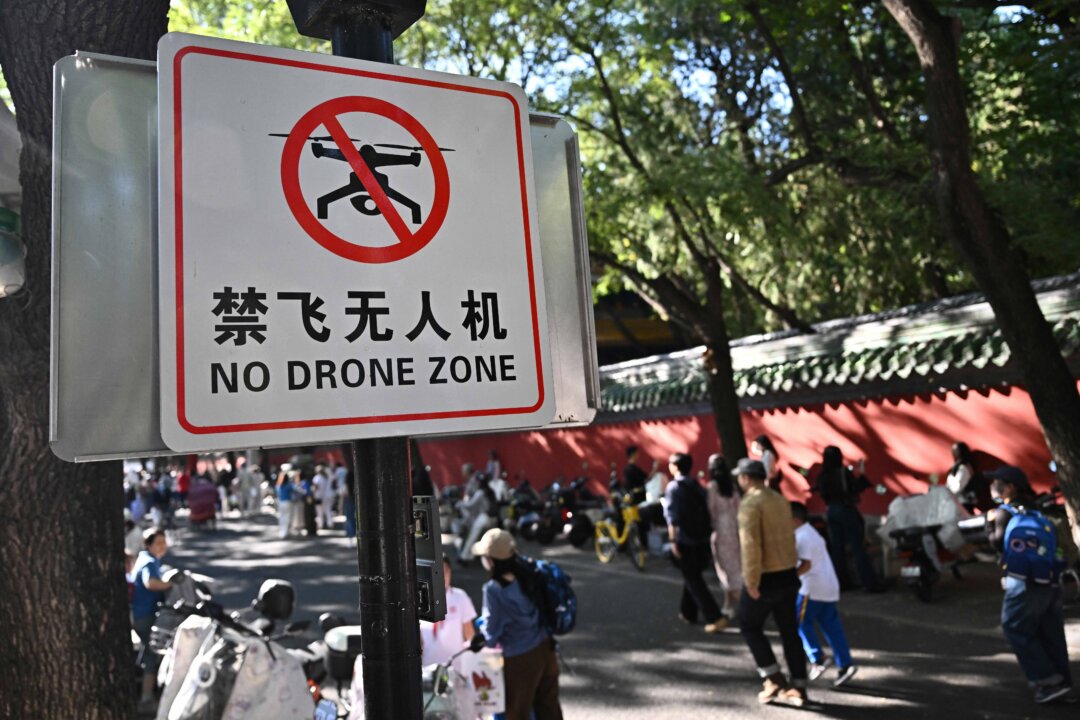
Beijing’s decision to effectively
eliminate
civilian drone ownership across the capital and impose flight restrictions across a 300-kilometer (186-mile) radius reflects more than a tightening of aviation rules, according to analysts who see the measures as a sign of growing insecurity within the Chinese Communist Party (CCP).
The total ban on residents owning and storing drones in the city’s vicinity will take effect on Nov. 15.
In addition, Hong Kong’s pro-Beijing media Ming Pao reported on Monday that starting from Sept. 20, a permanent FAA NOTAM will take effect within a 186-mile radius extending from Tiananmen Square in the center of the city. All flights will be restricted, except commercial, military, and emergency flights.
The expanded controls come after a small aircraft
crashed
into Beijing’s tallest skyscraper in June despite the capital’s extensive airspace restrictions. However, rather than limiting restrictions to sensitive sites or potentially dangerous aircraft, Beijing is extending controls across a huge geographic area and targeting even small civilian drones and their components.
Su Tzu-yun, researcher at Taiwan’s Institute for National Defense and Security Research, told The Epoch Times the measures indicate that the CCP is increasingly concerned about even relatively minor security vulnerabilities.
“These bans are an indicator of the unease of the CCP regime,” Su said, adding that the ban was related to a small aircraft that crashed into the CITIC Tower in June.
He added that the significance of the policy extends beyond the aircraft incident.
“The signal is that to maintain regime security, the CCP has already reached the stage of being extremely fearful of everything,” he said.
Su argued that the potential threat posed by small drones does not by itself explain the breadth of the restrictions.
“Logically speaking, even if this kind of small drone has an intention to attack, it would not cause too much damage,” he said. “The CCP is trying to avoid the effect of a spark, so it has issued the strictest ban.”
Unusually Broad Approach
Countries around the world regulate drone flights around airports, military installations, government buildings, and other sensitive locations. Su said Beijing’s approach stands out because of the size of the area covered and the extent to which restrictions reach into ordinary civilian activity.
All countries have regulations on drones, he said. However, they are usually limited to specific areas. Beijing, though, is designating the entire city.
He explained that regulations in other countries generally distinguish between larger drones that could pose greater risks and small recreational aircraft operated at low altitudes.
The new restrictions, therefore, offer a window into how Beijing defines security, according to Su. Rather than assessing threats according to the actual capabilities of individual devices, the regime appears to be trying to eliminate an entire category of potential vulnerabilities.
He said the drone restrictions point more broadly to distrust, not only of ordinary Chinese people but potentially of people working within the regime itself.
A drone can provide images of sensitive locations and movements, including the routes of senior officials, the formation of motorcades, and entrances and exits at important buildings, he said. However, that concern does not explain why such a vast area would be placed under restrictions.
“The scope designated by Beijing is too large and completely unreasonable, and it also highlights the guilty conscience of the CCP regime,” he said.
A Beijing-based journalist told The Epoch Times the restrictions reflect what he described as the extreme expansion of the regime’s “stability maintenance,” a term used by the CCP referring to tactics to safeguard the Party’s absolute control. He spoke on condition of anonymity out of fear of reprisal.
“The CCP’s social stability maintenance has now reached a state of extremity,” the journalist said. “Everything must conform to absolute security. This absolute security has now evolved into comprehensive control over drones.”
Limits of an ‘Absolute Security’ Approach
Su said the regime could face high costs if it attempts to eliminate civilian access to drones and their components.
He pointed to the broader enforcement challenge of trying to prevent people from obtaining even individual parts of a drone.
The journalist said signs of an informal market are already visible. On Chinese online shopping platforms, drone components can still be offered for sale, although sellers may list them by model number rather than explicitly describing them as drone parts.
The issue illustrates what the journalist described as a familiar pattern in China—increasingly stringent rules followed by efforts by ordinary people to find ways around them.
“There will definitely be policies from above and countermeasures from below,” he said.
Su also questioned whether tighter controls could address the underlying weaknesses that allowed the CITIC Tower crash to occur in the first place.
He linked the drone crackdown to the broader security environment surrounding Chinese leader Xi Jinping’s
purge
of the military, which he said had also affected military and police units in Beijing and created a chilling effect.
Yet the June airplane crash occurred despite the heightened security environment.
Su said the episode could point to a broader problem in a regime that seeks to eliminate every possible source of risk through increasingly expansive controls.
The result, he said, may be a security system that becomes increasingly restrictive without necessarily eliminating the vulnerabilities it was designed to prevent.
Tang Bing and Luo Ya contributed to this report.




Jimmy Lai’s Son Pleads for Ailing Father’s Release Ahead of Xi’s U.S. Visit
WASHINGTON—The son of imprisoned Hong Kong publisher Jimmy Lai has appealed for...
Experts Urge US, China to Prevent Rogue AI Causing Nuclear Crisis
A security expert from the United States and her counterpart from China...
Thousands in China’s Yunnan Province Resist Forced Cremation, Escort Coffins to Graves
Thousands of residents in a county in China’s Yunnan Province have gathered...

China Hosts Iranian FM Ahead of Trump–Xi Meeting; EU Will ‘Use All Tools to Cut China Trade Deficit’
Iran’s foreign minister is in Beijing as China weighs its role in...