Families Call for Release of Loved Ones in China as Xi Visits US
 Eva FuUpdated 2 hours Ago9 Mins read
WASHINGTON—These are the faces that Beijing doesn’t want the world to see.
They are political prisoners, ranging in age from their early 20s to nearly 80, each held behind bars because their beliefs or speech do not align with the Chinese Communist Party (CCP).
Each of them is a father or a mother, a son or a daughter. In the United States and elsewhere, someone is thinking of them, waiting for the day they will be allowed to go home.
Among those waiting are a mother of an 8-year-old, and a daughter undergoing chemotherapy, wishing to hold her father’s hand.
As the U.S.–China summit looms over Washington, advocates see an opening to make that happen.
One phone call to Beijing from the Oval Office, they argue, and these detainees could walk free.
On Capitol Hill, the plight of the political prisoners has galvanized bipartisan lawmakers ahead of the bilateral talks.
House Speaker Mike Johnson (R-La.) said at a presser that he believes the “release of the hostages” is on the agenda.
Five Democratic lawmakers have also presented the president with the names of 22 prisoners he could bring up with Chinese counterparts.
Rep. Chris Smith (R-N.J.) hosted two hearings this month championing their cause.
“It’s like that could be me. That could be my wife if she lives in China,” he told The Epoch Times.
“We’re all God’s children. If we don’t raise [this cause], who will?”
Butterfly in the Kitchen
On the kitchen counter of her Florida home, Ziba Murat keeps an embroidered image of a swallowtail butterfly.
It’s a small, tangible piece of Gulshan Abbas, Murat’s reticent mother, who’s now in Chinese jail under a 20-year sentence on terrorism-related charges. The United States has deemed those accusations as unfounded.


(Top) Ziba Murat holds a photo of her mother, Dr. Gulshan Abbas, at Murat’s home in Virginia in 2024. (Bottom) Ziba Murat keeps a framed image of a butterfly that was cross-stitched by her mother, jailed political prisoner Dr. Gulshan Abbas, in her kitchen. Courtesy of Ziba Murat
It was hard for Murat to connect the person she knows so intimately with the reality of life in prison. Abbas, as Murat remembers, smiled quietly at jokes and embroidered for hours with a patience Murat never possessed.
Even after retiring, Abbas continued to go out of her way to help Uyghur patients, getting up early to meet them at the hospital just so they could see the right doctor and have everything they needed, Murat told The Epoch Times.
Murat misses her. She misses her mother’s humming in the kitchen and the wonderful stir-fries she cooked during the months she spent visiting the United States.

When it was time for Abbas to leave in 2016, Murat wanted her to stay.
She remembers her mother telling her: “I have a 10-year-visa. I can come back anytime I want.”
Murat said she had a sinking feeling as she watched her mother disappear through airport security. That was the last time they saw each other in person.

(L–R) Ziba Murat; her mother, Dr. Gulshan Abbas; and her younger sister Zamira Murat during a 2015 visit to the United States by Abbas, in this file photo. Courtesy of Ziba Murat
For the next two years, the two talked on the phone every day. Then in 2018, days after Abbas’s sister Rushan made a public speech denouncing the Party’s mass detention of Uyghurs, Abbas became unreachable. It took two years for her family to learn of her imprisonment and sentencing in a secret trial.
Holding her baby daughter, Murat walked around Congress frantically looking for help. Never a news junkie, she became glued to the screen, scanning for the slightest hint of change in U.S.–China policy.
Guilt gnawed at Murat as she wondered what she could have done, thinking about how she was here in the United States living her life while her mother was suffering in a Chinese jail.
Murat still can’t bring herself to tell the truth to her 8-year-old daughter.
When the girl saw a photo of Rushan holding a photo of Abbas, she asked Murat what was going on.
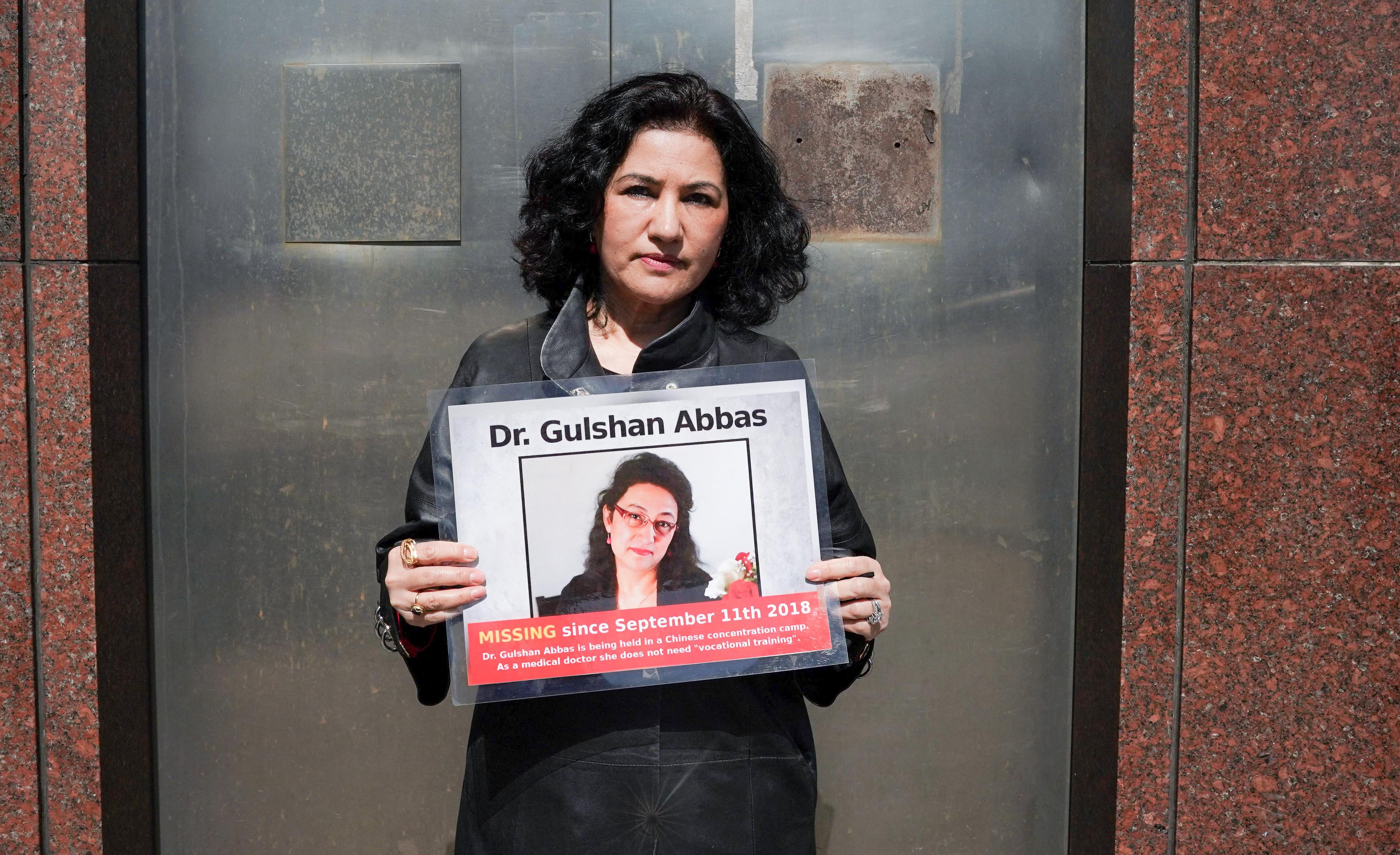
Rushan Abbas, executive director of the Campaign for Uyghurs, holds a photo of her sister, Dr. Gulshan Abbas, during a rally in New York City on March 22, 2021. Dr. Gulshan Abbas, a retired Uyghur medical doctor, was sentenced in a secret trial to 20 years imprisonment for alleged terrorist activities. Timothy A. Clary/AFP via Getty Images
Murat responded that her grandmother was “very far away” and that they were asking people to bring her back.
Through all these years, Murat said, the girl hasn’t hugged her grandmother. She knows her grandmother through stories, photographs, and the hope that one day they will finally meet.
“That’s the cruelty of transnational repression,” Murat said at a Sept. 16 event on China’s religious freedom. “It did not harm only one person. It steals birthdays. It steals holidays, ordinary family moments that you can never get back.”


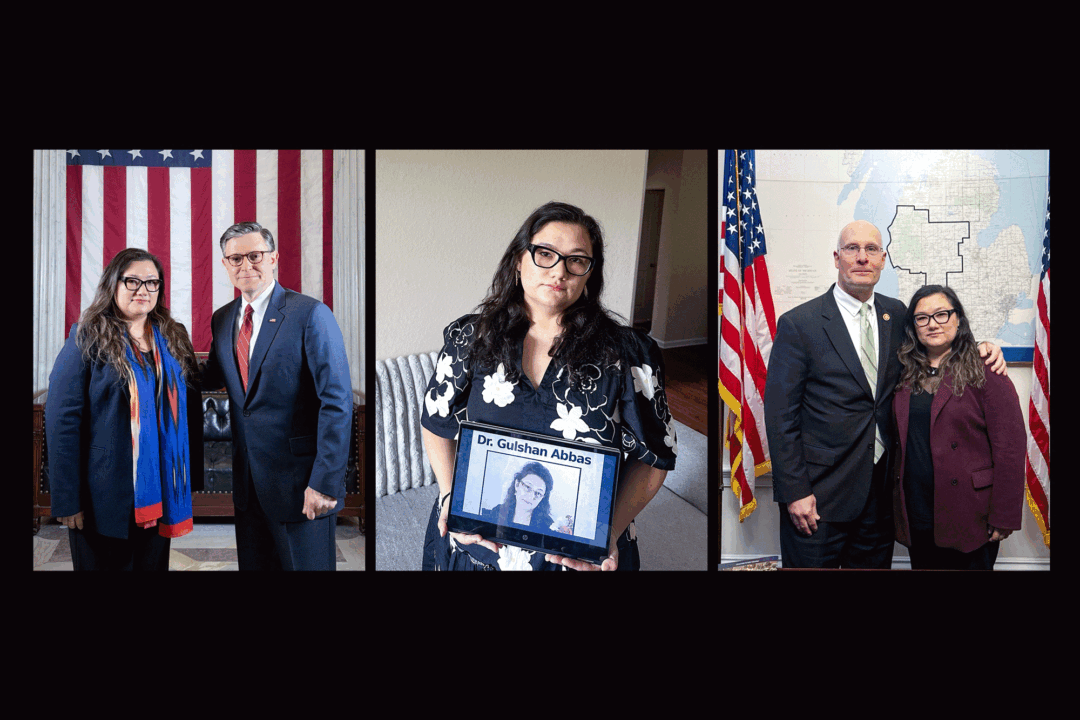
(Top) Dr. Gulshan Abbas’s image is shown during a congressional hearing by the House Select Committee on the Chinese Communist Party titled “The Chinese Communist Party’s Ongoing Uyghur Genocide,” in Washington on March 23, 2023. (Bottom Left) Ziba Murat with House Speaker Mike Johnson (R-La.) during a visit for the State of the Union address in Washington on Feb. 24, 2026. (Bottom Right) Ziba Murat with Rep. John Moolenaar (R-Mich.), head of the House Select Committee on the Chinese Communist Party, in Washington in March 2026. Courtesy of Ziba Murat
A Card From Jail
Alisa Zhou experienced that cruelty when she was around 7 years old.
It was 2000, one year after the Chinese regime went all out against her faith, Falun Gong.
The meditative practice spread widely by word of mouth in the 1990s, reaching an estimated 70 million practitioners by decade’s end. Then, in 1999, the Chinese leadership ordered a full-fledged eradication campaign. Overnight, the practitioners became outlaws.
Zhou was too young to make sense of it all, and her father tried to shield her from the hard reality. When her mother, Wang Youmei, vanished suddenly, he told Zhou that she had gone on a business trip far away.
But the persecution found a way to reach Zhou. After her mother’s arrest, Zhou’s best friend, with whom she walked to and from school every day, stopped playing with her. Then her father took her to an unfamiliar place.

Her mother was there. She handed Zhou a bag of snacks and a handwritten card.
One message is etched into her memory: her mother’s wish that her children “grow up healthy and happy.”
The young Zhou cried as she took in the words. Some time later, she grasped that her mother was in jail.
There were a lot more tears during those nights when Zhou was alone. To encourage herself, she wrote down “truthfulness, compassion, and forbearance”—the three core principles of Falun Gong—and hung it on her bedroom wall.

Alisa Zhou holds a photo of her mother, Wang Youmei, in Rockville, Md., on May 6, 2026. Wang was arrested in China in April 2026 for practicing Falun Gong. Madalina Kilroy/The Epoch Times
More than two decades later, the same three words keep Zhou going after her mother’s fifth arrest this April.
She had learned about it while driving to Virginia Beach for a weekend retreat. Back at work on Monday, she burst into tears when her boss greeted her with “How was your weekend?”

Zhou is now an American citizen. But despite living in the free world, the persecution follows her like a shadow, she said.
“There’s not a moment where I can shake it off,” she told The Epoch Times. Whenever she trawls the internet for information on China, she’s haunted by revelations of new arrests and deaths.

Maryland accountant Alisa Zhou. Her mother has been detained in China since April over her practice of Falun Gong. Madalina Kilroy/The Epoch Times
Believing in truthfulness, compassion, and forbearance poses no threat to anyone, Zhou said, but if the CCP is out to get someone, “there’s no shortage of excuses.” She said she can’t fathom how a state could turn on its own people.
Neither can Smith, the co-chair of the bicameral Congressional-Executive Commission on China that monitors human rights in the communist country.

“I’ve been in Congress for 46 years. I don’t get it,” he said.
“These [people] are assets to your country. … This is the salt of the earth—Christian believers, Falun Gong practitioners, the Uyghurs, Tibetan Buddhists. Why would you look to hurt these people?
“Let them thrive, and your nation thrives.”
To Hold a Daughter’s Hand

It’s difficult to know how many political prisoners there are in China. The Chinese regime doesn’t provide such information and asserts that it doesn’t hold them.
A database from human rights nonprofit Dui Hua Foundation, last updated in December 2025, recorded more than 50,000 entries. The Congressional-Executive Commission on China has tracked more than 11,000 cases. Neither comes close to the true number, advocates say.
“It’s millions of people that have to go through that,” Sam Brownback, former ambassador at large for international religious freedom, told The Epoch Times. “These are people that have families like I do, and they’ve just done what they believe is right and stood up for freedom.”
In Hong Kong, the number of political prisoners has also been rising over the six years since Beijing imposed a national security law to crush dissent.

Sam Brownback, former U.S. ambassador-at-large for international religious freedom, speaks during an event at the Museum of the Bible in Washington on Sept. 16, 2026. Madalina Kilroy/The Epoch Times
One of the most prominent is Jimmy Lai, founder of one of the largest pro-democracy newspapers in Hong Kong, which folded following a 500-strong police raid in 2021.
His daughter Claire was diagnosed with cancer weeks ago and just started chemotherapy in London.
Lai received the news at the maximum-security prison where he’s serving a 20-year sentence.
At a Sept. 16 hearing highlighting Lai’s case, Claire’s brother Sebastien pleaded for compassionate release so that their father could “sit beside his daughter in her hardest moment” and hold her hand.
“She wants nothing more than to have him with her for this fight,” Sebastien Lai said.

Sebastien Lai Sung-yan, son of jailed Hong Kong media mogul Jimmy Lai, poses for a photo following a news conference in London on Dec. 15, 2025. Henry Nicholls/AFP via Getty Images
Sebastien Lai said he hears about his father’s health declining every single day.
In a report two days before the hearing, the Committee for Freedom in Hong Kong Foundation found that Hong Kong prison guards have rehearsed Jimmy Lai’s death.
“It’s really scary to hear,” Sebastien Lai said.
The Hong Kong authorities’ actions against his father are a “real disgrace,” he said. “They went through all this kangaroo court show trial and found nothing. His record is unblemished, yet they still keep going.”
The Long Game
Jimmy Lai is one of an estimated 2,000 Hong Kong pro-democracy figures ensnared under the national security law.
Former student leader Joshua Wong is currently awaiting sentencing for “foreign collusion” for lobbying Western lawmakers, and potentially faces life in prison.
For democracy activist Frances Hui, who has a HK$1 million (about $127,000) bounty on her head, the word that comes to mind is “horror.”

Activists Joshua Wong (C) and Ivan Lam (R) board a police van before being taken to court to be sentenced over a 2019 protest that took place outside the city’s police headquarters, at a maximum-security correctional facility in Hong Kong on Dec. 2, 2020. Anthony Wallace/AFP via Getty Images
“I knew [Wong] when he was 16; I don’t know if he will ever come out alive, or if I will ever be able to see him,” she told The Epoch Times.
Wong was already serving a four-year, eight-month prison term. Seven months before Wong was due to be released, prosecutors began a second trial.
“They waited until the very end to come up with this charge. It’s just so apparent that they are trying to keep him behind bars for as long as they can,” Hui said.

The two met when they were both teenagers campaigning for Hong Kong’s democratic freedoms. Wong, in Hui’s telling, had a lot of energy, taking interviews even while on hunger strike and physically frail.
“He inspires so many of us,” Hui said, suggesting that the Party authorities are acting out of fear.
“They are afraid that if he gets out next year, he will create something that they can’t control.”

Frances Hui, policy and advocacy coordinator at the Committee for Freedom in Hong Kong Foundation, speaks during a Tiananmen Square massacre candlelight vigil held at the Victims of Communism Memorial in Washington on June 4, 2026. Madalina Kilroy/The Epoch Times
The regime is playing the long game, she said, betting that over time, the outside world will “forget the prisoners as they slowly go quiet.”
The families of the prisoners fear forgetting, too.
At a recent human rights panel, Uyghur lawyer Rayhan Asat held up a photo of her brother, Ekpar, who was detained upon returning from a 2016 U.S. exchange program.
They had seen each other that March. She was studying at Harvard Law School and expecting to see him at her graduation ceremony in two months. She regrets not taking many videos of them together. After 10 years of separation, it’s now difficult to imagine what he sounds like.
“That’s a very painful thought,” she said.

Rayhan Asat, Atlantic Council senior legal and policy adviser and China lead, and sister of political prisoner Ekpar Asat, speaks in Washington on Sept. 15, 2026. Madalina Kilroy/The Epoch Times
Hope for a Miracle
The release of Pastor Ezra Jin in July is helping to keep their hopes alive.
After nearly nine months in custody, the Zion Church leader walked onto a plane bound for the United States and was reunited with his family.
Chinese authorities charged him with fraud and illegal business operations—allegations frequently used to prosecute religious activities in China. They told him they could imprison him for 15 years but would be lenient if he pleaded guilty. He refused.

On July 3, he was pulled from prison and sent in an empty train car to the airport. Even after stepping onto the plane, Jin said, he had no idea where he was going. He had no paperwork or visa.
He arrived on July 4—America’s 250th birthday. It felt like a dream. The previous day, he was a prisoner. The following evening, he was sitting by the seaside, watching fireworks with family he hadn’t seen in eight years.
Many had thought it was mission impossible, he said, as he accepted an award in July celebrating his freedom. He thanked Trump and many human rights advocates for their support.
“When we stand together, changes do happen,” he said.

Former political prisoner Pastor Ezra Jin Mingri in Washington on Sept. 16, 2026. Madalina Kilroy/The Epoch Times





FIRST READING: David Eby’s snap election could blow up in his face
David Eby holds a news conference in a B.C. liquor Store on...
Permanent resident who sexually interfered with girl, 15, aimed to dodge deportation
Hamilton's John Sopinka Courthouse. Photo by Peter J. Thompson/National PostArticle contentA Hamilton,...
Vivian Bercovici: Belleville shooting is the inevitable result of unchecked Jew-hatred
Officials with the Special Investigations Unit are seen exiting an SIU vehicle...

Heather Exner-Pirot: Carney’s oil and gas renaissance
Prime Minister Mark Carney puts on a hard hat at the Canadas...