
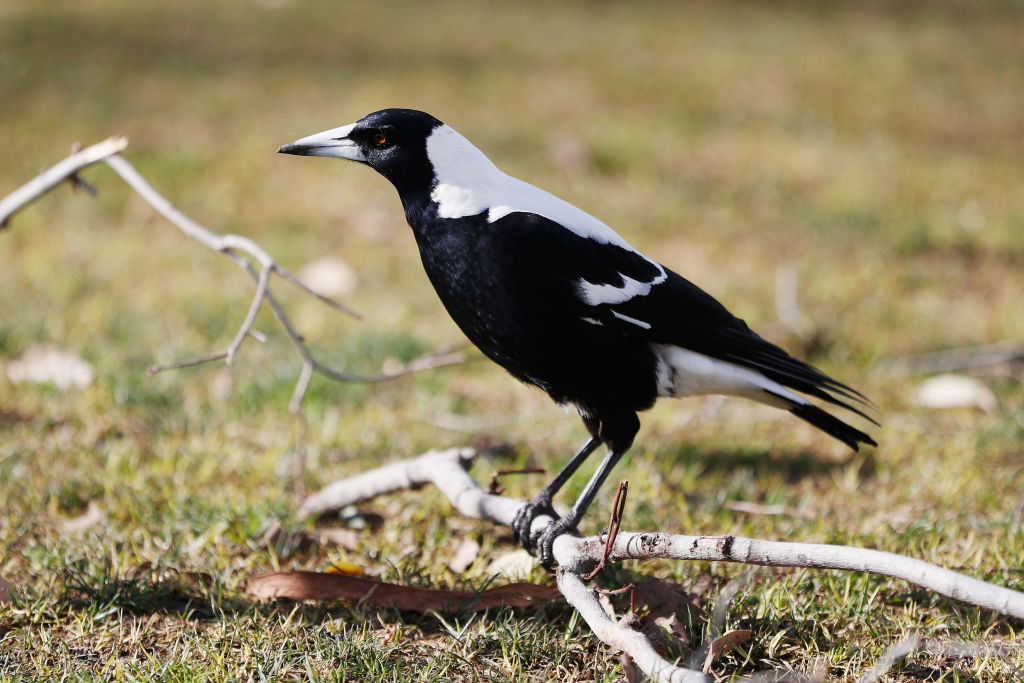

A black and white Australian magpie stands on a branch in a grassy area at Melbourne Cricket Ground in Australia on July 30, 2017. Michael Dodge/Getty Images
It was a case of fowl play as a mysterious intruder ruffled more than a few feathers in Brisbane.
On Aug. 21, the Queensland Police Service officers arrived at a house in the leafy suburb of Tarragindi in response to reports of an intruder.
But as they arrived and started searching the two-storey home, the feathered felon was revealed to be a native magpie.
Police said the home’s occupants did the right thing by going to police after suspecting someone was inside their home.
Senior Sergeant Murray Cumner, the officer in charge of Upper Mount Gravatt Tactical Crime Squad, said police treat every call-out with seriousness.
“When a member of the community believes their safety may be at risk, we will respond and thoroughly assess the situation,” Senior Sergeant Cumner said.
“In this case, the intruder turned out to be a magpie rather than a person—which was fortunate for everyone involved.”
Police utilised the opportunity to remind people to secure doors and windows where possible to prevent unlawful entry.
Magpies Interested in New Spaces: Academic
Professor Amanda Riley, a behavioural ecologist at the University of Western Australia, said magpies, like other avian species, were able to persist—and thrive—in urban environments because of their relatively low “neophobia”—fear of new spaces.
“They show an interest in exploring new and novel objects,” she told The Epoch Times.
“This can allow them access to new and novel food sources some cases.”
Ridley said their level of curiosity and lack of fear was an advantage in adapting to changing environments, but could be a disadvantage when it came to getting stuck in houses.
Magpies are found across most of Australia in great numbers.
Magpie Most Commonly Sighted Bird
The 2025 Aussie Bird Count results released in May this year showed magpies were the most commonly sighted bird of 5 million counted during a week of spotting in October.
A total of 64,000 Australians took part in the “citizen scientist” bird-counting exercise.
The rainbow lorikeet came in second, while noisy miners, sulphur-crested cockatoos, magpie larks, galahs, red wattlebirds, crested pigeons, welcome swallows, and the common myna made up the rest of the top 10.
“Because rainbow lorikeets are more social, hanging out in flocks, when we see them, we see more of them,” said BirdLife Australia’s national public affairs advisor Sean Dooley.
“But the magpie is the bird we encounter most often. Every second person who did the count last year added a magpie to their list.”