

Economists say the new U.S. tariffs and Canada’s counter-tariffs could have a severe impact on affected Canadian industries, potentially rendering some businesses unprofitable while prompting others to move south.
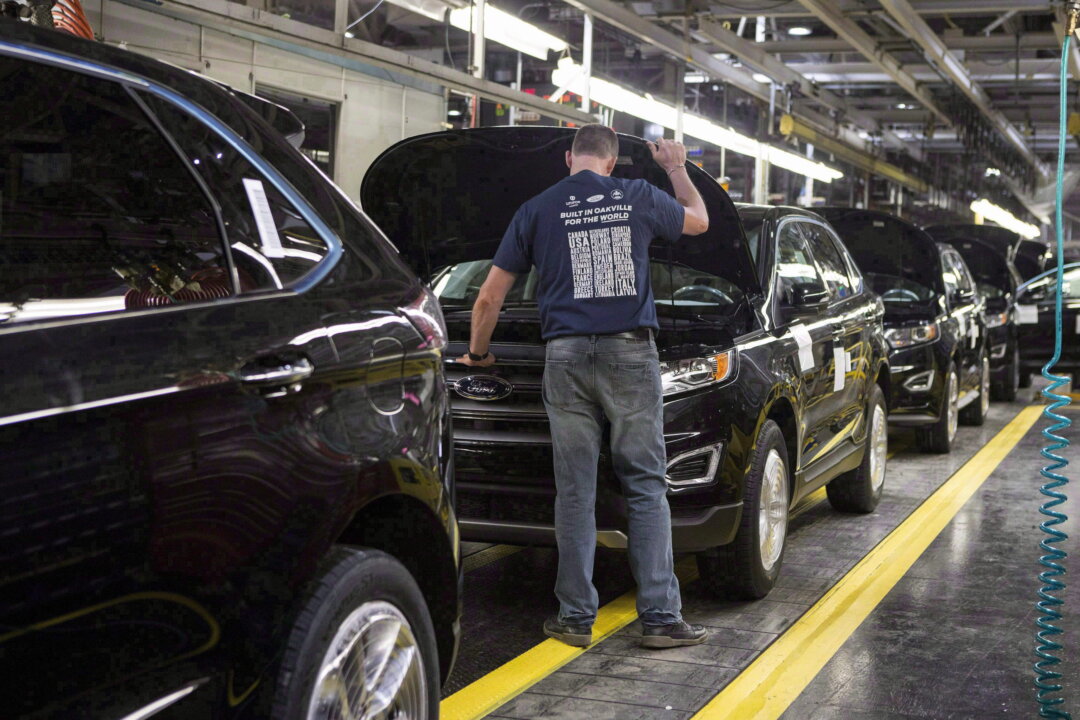
Some say that if Washington follows through with its threat to impose 50 percent tariffs on Canadian automobiles in 2027, it could mark the end of Canada’s auto industry if the tariffs remain in place for the long-run.
“It’s pretty serious for the industries involved, it’s really going to land heavily on a lot of small- and medium-sized sectors, and it’s going to be a challenge for Ottawa to fully support all of these industries,” BMO Financial Group’s chief economist Doug Porter said in an interview.
Negotiations between Ottawa and Washington broke down at the 11th hour on Aug. 21, prompting the United States to follow through with its threat to impose additional 50 percent tariffs on $28 billion worth of Canadian products beginning on Aug 22.
U.S. President Donald Trump announced two days later that he also plans to impose 50 percent tariffs on Canadian vehicles and auto parts after Canada said it would introduce dollar-for-dollar counter-tariffs.
As a countermeasure to the tariffs on $28 billion of goods, the Canadian government announced its plan to establish an equivalent tariff structure on the United States, which includes tariffs ranging from 15 to 50 percent on hundreds of American products.
Carleton University business professor Ian Lee said the trade war between Canada and the United States will increase costs for both countries, but Canada will ultimately be more damaged by the conflict. Lee also said Canada’s retaliatory tariffs on the United States will be detrimental to Canadian companies that do not operate with profit margins reaching 50 percent.
“We will just simply stop the trade in those products,“ he said in an interview. ”When [the tariffs] become that big, no importer is going to absorb that, because they know they can’t pass it on. So what it’s doing is it’s literally killing trade.”
US Tariffs Impact
The impact of U.S. tariffs will not be evenly felt by Canadians because they will affect some business sectors and provinces more than others.
Jack Mintz, President’s Fellow of the School of Public Policy at the University of Calgary, said the current array of U.S. tariffs imposed on Canada means the majority of Canadians will probably not notice the effects of the new tariffs at first.
“It’s not that we haven’t had tariffs already, and the Canadian economy still percolates along. Not particularly with great growth, but it’s not the end of the world,” he said.
However, the prolonged impact of the tariffs would bring about significant economic and job losses, economists say.
University of Calgary Economics Professor Trevor Tombe says that while the new U.S. tariffs apply to a “relatively small share” of what Canada exports to the United States, it would likely raise the average tariff rate of Canadian exports by another 2.5 percent.
However, Tombe said if the U.S. tariffs were to remain in place, nearly 90,000 jobs across Canada could be lost, and unemployment could rise from 6.4 percent to 6.8 percent. He said these losses would be concentrated in Ontario, Quebec, and British Columbia, but leave Alberta, Saskatchewan, and the Atlantic provinces “largely spared.”
Tombe projected in an analysis for the Hub that the largest amount of job losses would be in the agriculture, fishing, and forestry sectors, computer and electronics manufacturing, textile and clothing manufacturing, furniture manufacturing, plastics and rubber manufacturing, and electrical equipment manufacturing.
He also said the tariffs would lead to large disruptions in transportation and warehousing, as lower trade volumes with the United States would mean less demand for those services.
The threat of more U.S. tariffs next year will bring even more change. Porter and Mintz said if Trump carries through on his plan to raise automotive tariffs from 25 percent to 50 percent, it would be a severe blow to the industry
Porter said it would not be economic to export any Canadian vehicles if tariffs were that high, while Mintz said 50 percent auto tariffs would “kill the auto sector” in Canada, especially if they also apply to automotive parts.
Mintz said that despite Ottawa attempting to diversify its trade with other countries, Canada’s economy is “deeply tied” to the United States, which also possesses a “much bigger hammer than we do.”
Impact of the Trade War
Lee said that the trade war will send additional signals to businesses operating in Canada that “maybe it’s the time to look at relocating their business to the states.” He cited a recent KPMG study that found 42 percent of manufacturing businesses are looking at relocating to the United States, and 77 percent of those businesses expect to do so within two years.
“The short-run impact will be price increases, and the longer-term impact—because you don’t just move your business the day after, it takes time—is going to encourage, enable, facilitate additional capital flight of Canadian businesses moving their business to the U.S.” Lee said.
Counter-Tariffs
Meanwhile, Canada’s counter-tariffs will be raising costs for Canadian consumers.
A study by the Bank of Canada found that Canada’s previous counter-tariffs raised the costs of targeted items by around 6 percent, with around 25 percent of tariffs being passed on to consumers.
Ottawa says its tariffs are strategic, and are meant to shield domestic producers against American competition, while also targeting certain states to put political pressure on Washington to reverse course on its tariffs.
Ottawa also says that it is introducing a $7.5 billion relief package to support affected workers and businesses. The offered support includes loan and financing programs for businesses, and flexibility for workers to more easily access employment insurance.