
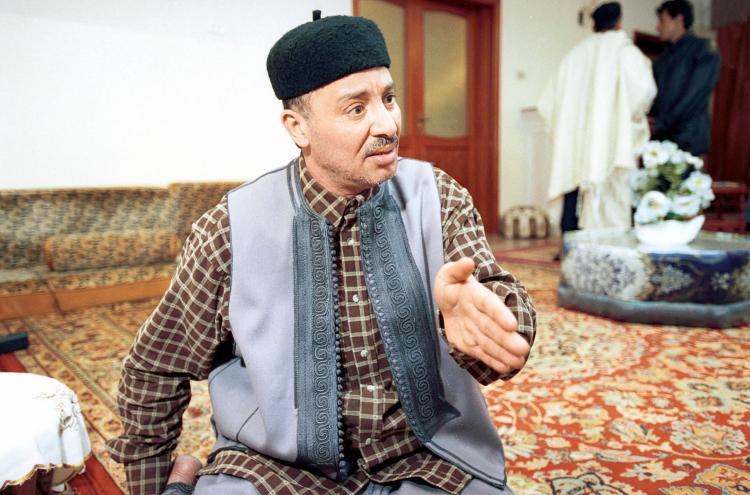
A former Libyan Airlines manager who was acquitted of being involved in the Lockerbie bombing, which killed 270 people when Pan Am Flight 103 was brought down as it flew over the Scottish town in 1988, has died in Libya.
Al Amin Khalifa Fhimah was found not guilty in January 2001 after a historic trial that was held, under Scottish law, at a military base, Camp Zeist, in the Netherlands.
His co-accused, Abdelbaset al-Megrahi, was convicted and jailed for life, with a recommendation that he serve at least 20 years in prison, but he was controversially released on compassionate grounds by the British government in August 2009 and died in Libya in 2012, still protesting his innocence.
This week, the alleged bombmaker, Abu Agila Mohammad Masud Kheir al-Marimi, was due to go on trial in a federal court in Washington, but U.S. District Judge Dabney Friedrich postponed the trial following a request from defense attorneys.
Fhimah, who died at age 70, had been the station manager with Libyan Airlines at Luqa Airport in Malta at the time of the Lockerbie bombing.
‘Profound Grief’
In a social media post on Aug. 25, the board of directors of Libyan Airlines said they were announcing Fhimah’s death “with deep sorrow and profound grief.”
The board stated that they extended their condolences and sympathy to his family.
Libyan Airlines announced in a separate social media post that his funeral took place in the Libyan capital, Tripoli, on Aug. 26.
Fhimah did not give evidence or call any witnesses at his trial, which began in May 2000 and ended on Jan. 31, 2001. However, his lawyer, Richard Keen, told the trial that the case against his client was entirely circumstantial and that he should be acquitted of all of the charges.
When the U.S. Department of Justice announced charges against Masud on Dec. 21, 2020, it laid out the history of the case.

Abu Agila Mohammad Masud Kheir Al-Marimi, the alleged Lockerbie bombmaker, in custody in Alexandria, Va., on Dec. 11, 2022. Alexandria, Va. Sheriff’s Office/Handout via Reuters
“Immediately after the disaster, Scottish and American law enforcement undertook a joint investigation that was unprecedented in its scope, and in November 1991, it led to criminal charges in both countries, charging two Libyan intelligence operatives, Abdel Baset Ali al-Megrahi (Megrahi) and Lamen Khalifa Fhimah (Fhimah) with their roles in the bombing,” it stated.
It was alleged at the pair’s trial that the Libyan leader, Muammar Gaddafi, had ordered the attack in revenge after the United States bombed Tripoli in 1986, killing his adopted baby daughter, Hana.
The U.S. bombing of Libya was itself retaliation for the April 1986 bombing of Berlin’s La Belle nightclub, which U.S. authorities attributed to Libyan agents. Two American soldiers were killed in the nightclub bombing.
Flight 103, which was bound for John F. Kennedy International Airport, exploded at 31,000 feet when a bomb in the plane’s forward cargo area detonated 38 minutes after takeoff from London’s Heathrow Airport.
Suitcase Bomb Planted on Plane in Malta
The bomb had been packed into a suitcase, which had been put on a connecting flight from Malta to Frankfurt, Germany. The suitcase was then transferred to Heathrow, where it was loaded onto the New York flight, even though there was no passenger accompanying it.
The bombing killed 190 Americans on board the plane, including 35 Syracuse University students and 43 British nationals, including 11 residents of Lockerbie.
U.S. federal prosecutors, ahead of Masud’s trial, allege that, in late 1988, he was summoned by his superior in Libyan intelligence to a meeting in Tripoli and was told to fly to Malta with a bomb in a Samsonite suitcase.
“He did so, where he was met by Megrahi and Fhimah at the airport,” reads the DOJ statement from December 2020. “After Masud spent approximately three or four days in the hotel, Megrahi and Fhimah instructed Masud to set the timer on the device in the suitcase for the following morning, so that the explosion would occur exactly eleven hours later.”
Megrahi and Fhimah were both at the airport on the morning of Dec. 21, 1988, the DOJ statement states, and Masud allegedly handed the suitcase to Fhimah. The statement notes that Fhimah then allegedly placed it on the conveyor belt.