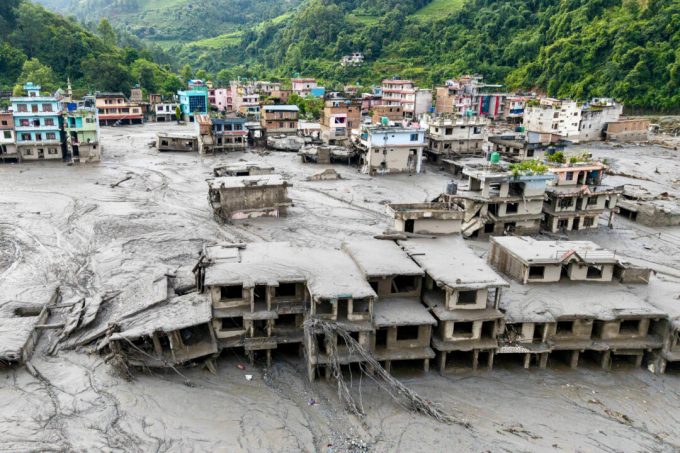

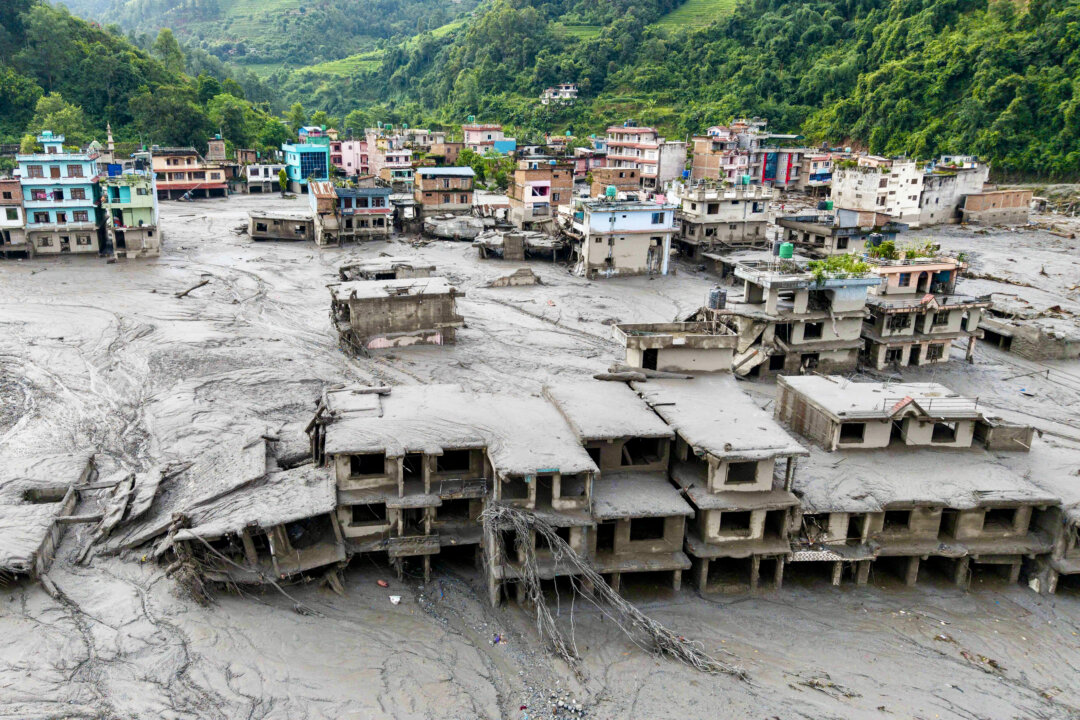
A growing dammed lake above a Nepal–Tibet flood zone is threatening Gyirong Port, where hundreds of people remain unaccounted for after the first catastrophic surge.
China’s Ministry of Water Resources estimated on Aug. 27 that the lake held about 2 million cubic meters (about 528 million gallons) of water and could receive another 3 million cubic meters over the next three days because of rain.
The ministry said the lake—which was created by mudslides near the junction of two different rivers—was already overflowing and faced high risk of a sudden release that could again hit Gyirong Port and areas downstream.
Drone reconnaissance by fire and rescue personnel found the lake’s surface expanding and its water level higher than the previous day, state-run Xinhua News Agency reported on Aug. 27.
Nepal’s National Disaster Risk Reduction and Management Authority (NDRRMA) said the blockage was about 11 miles upstream of Rasuwagadhi and had created a lake covering roughly 27 acres.
Nepalese authorities urged residents, travelers, and rescue personnel along the Bhote Koshi River corridor to stay away from riverbanks and other high-risk areas.
The warning comes as the toll from the first flood continues to rise.
An NDRRMA update issued on Aug. 27 reported 359 bodies recovered and 910 people still out of contact in Nepal.
Across the border, the Gyirong disaster command reported three deaths and 558 people missing in Tibet, including 260 foreign nationals, as of 8 a.m. on Aug. 27.
Lake Still Rising
The new lake formed in debris left by the disaster near the confluence of the Cuojian River and Purepuqiang Zangbo, upstream of Gyirong Port.
Chinese authorities on Aug. 27 found that the broader landslide area had not expanded, but the lake surface continued to grow.
Water was already passing over the natural barrier rather than remaining contained behind it. Authorities described the condition as overflowing but not a full breach.
Natural dams are formed suddenly from loose rock, soil, and other debris rather than engineered materials.
According to National Cheng Kung University resource-engineering professor Huang Jing-sheng, water penetrating such debris can increase internal water pressure and reduce the friction helping hold the blockage together.
Historical records compiled by Taiwan’s Agriculture Ministry identify erosion from water flowing over the top as one common failure mechanism for natural dams.
The agency cautions that historical cases cannot predict how a particular lake will behave.
New Hazard Complicates Access
The dammed lake sits above an area already heavily damaged by the first flood.
The edge of the debris flow was located about 1.6 miles from Gyirong Port, with deposits approaching five feet thick in places, Xinhua reported.
An engineering team was using drones and 3D laser scanners to survey the blockage and measure its shape, surrounding rock, and water flow, according to Chinese rescue authorities, who said the upstream threat had to be addressed before crews could safely clear the large debris field closer to the port.
On the Nepal side, the new danger extends directly into the rescue corridor.
The NDRRMA and Nepal’s hydrology authorities urged residents, travelers, and rescue personnel along the lower Bhotekoshi to remain away from riverbanks and other exposed areas.
That warning is tied to the newly formed lake, not the initial flood surge.
More Water Forecast
China’s National Meteorological Center continued to forecast additional rainfall around Gyirong through Aug. 29.
Gyirong Port was expected to see light rain overnight on Aug. 27 and into Aug. 28, with moderate rain at times.
Rain was forecast to intensify on Aug. 29, with light to moderate rain and periods of moderate to heavy rain.
Along the corridor from Gyirong Port toward Nepal, the China Meteorological Administration’s public weather service forecast moderate to heavy rain on Aug. 27, moderate rain on Aug. 28, and moderate to heavy rain again on Aug. 29, with possible thunderstorms, strong winds, and hail.
A Chinese water ministry hydrological assessment put inflow into the lake at about 15 cubic meters per second (about 3,963 gallons per second) and said the volume was still increasing.
Based on the rainfall forecast, the ministry estimated that the lake could receive another 3 million cubic meters of water over the next three days.