
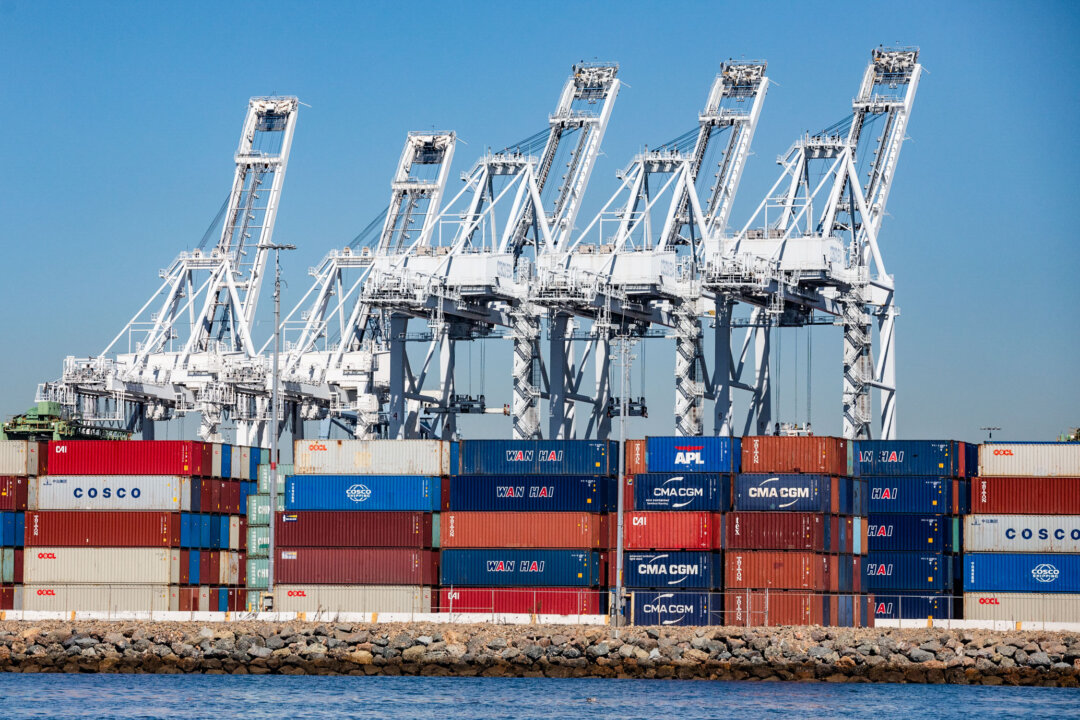
The U.S. goods trade deficit widened to its highest level in more than a year as imports climbed and exports decelerated in July, new government data show.
Last month’s international merchandise trade gap rose by 17 percent, or more than $17 billion, to a seasonally adjusted $118.8 billion, according to the Census Bureau on Aug. 27.
It was the largest deficit since March 2025, when companies were front-running U.S. tariffs.
Economists had forecast a goods deficit of $99 billion.
Imports rose by almost 4 percent to about $318 billion and were up about 14 percent from the same time a year ago.
An 11 percent increase in foreign capital goods—the largest since 1993—accounted for almost all of the sizable jump in imports, reflecting the ongoing artificial intelligence infrastructure buildout.
Inbound shipments of consumer goods also ticked up by 0.1 percent.
Conversely, imports of industrial supplies and automotive vehicles fell by 3.9 percent and 1.6 percent, respectively. Foods, feeds, and beverages also slipped by almost 1 percent.
“Standard macroeconomics is winning out over the Trump tariffs—a big budget deficit plus a surge in investment in an import heavy sector would normally result in a big trade deficit,” Brad Setser, senior fellow at the Council on Foreign Relations, said in an X post.
“But also worth noting that the key inputs for the AI/data center buildup have essentially been excluded from the tariffs—there aren’t tariffs on imported chips or imported computers.”
Merchandise exports declined for the third consecutive month after hitting a record high in April.
U.S. outbound shipments slipped by nearly 3 percent to $199.4 billion in July.
American companies shipped fewer industrial supplies (down 11.2 percent); foods, feeds, and beverages (minus 1.4 percent); and automotive vehicles (down 0.7 percent).
The U.S. goods trade deficit has been volatile this year as the global economy has navigated the war in Iran, changing tariff rates, and a fluctuating U.S. dollar.
Despite President Donald Trump’s expansive tariff agenda since returning to the Oval Office, the trade deficit has shown little improvement this year.
‘Don’t Need Canada’
The United States is engaged in tit-for-tat trade strife with Canada after Ottawa abandoned negotiations at the last minute this past weekend.
Instead of striking a trade agreement with its southern neighbor, Canadian Prime Minister Mark Carney will impose counter-tariffs on various U.S. products in response to the White House’s decision to raise levies on about $28 billion in Canadian goods.
The prime minister said that U.S. trade demands were unjust, citing grievances surrounding French-language rules.

U.S. Trade Representative Jamieson Greer speaks to reporters at the White House on Oct. 30, 2025. Madalina Kilroy/The Epoch Times
But U.S. Trade Representative Jamieson Greer told reporters that this issue has been misrepresented by Ottawa, noting that the complaints targeted streaming rules rather than French labeling.
“There have been in the past discriminatory laws that target U.S. streaming companies that say you have to give five per cent of your earnings to fund your competitors,” Greer said in an Aug. 26 interview with CBC.
“So, this is not something where we push hard, or condition, or red-line. It’s like the farthest thing from a red line. We were really focused on those taxes.”
In the meantime, there are “no open channels” between him and Canadian Trade Minister Dominic LeBlanc, Greer said.
Trump, meanwhile, said on his social media platform that the United States does not need anything from its second-largest global trading partner.
“They feel entitled, and yet, WE DON’T NEED CANADA, THEY NEED US!” the president wrote in an Aug. 24 Truth Social post. “They do 95 percent of their business with the U.S., with us, the exact opposite!”
Almost three-quarters of Canadian merchandise exports are shipped to the United States.
Economists warn that the prime minister’s retaliatory tariffs will hurt Canadian consumers rather than the U.S. economy.
“Avoiding signing a bad trade deal is one thing, but deciding to raise taxes on Canadians is quite another,” Renaud Brossard, vice president of communications at the Montreal Economic Institute, said in a statement to The Epoch Times.
“The Carney government’s response to U.S. tariffs should focus on building a stronger Canadian economy; unfortunately, retaliatory tariffs will have the exact opposite effect.”
The group noted that Canada’s cost of living has soared by more than 24 percent since 2020.
The Federal Reserve Bank of St. Louis placed U.S. inflation at 27 percent over the same period.