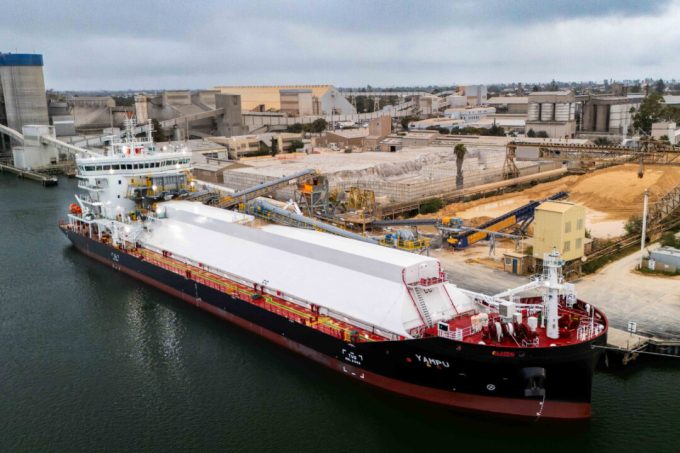

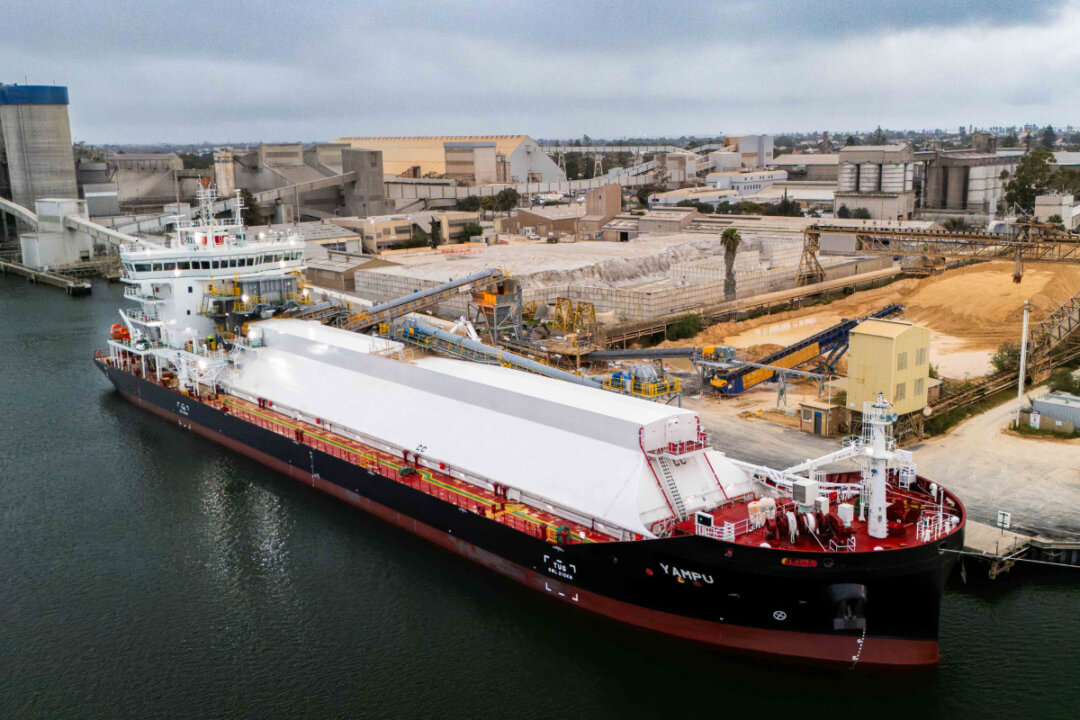

The MV Yampu, discharges inaugural limestone cargo at Birkenhead, South Australia. (Courtesy of CSL).
The world’s first battery-powered self-unloading bulk carrier has begun operations in South Australia, and is expected to reduce emissions by 40 percent while increasing capacity by 35 percent compared to the previous diesel-powered vessel.
The MV Yampu is 125 metres long and has a capacity of 11,900 deadweight tonnes. Its batteries have a capacity of 6,758 kWh—enough to power about 448 average Australian homes for a full day.
The vessel’s batteries will help secure a vital raw material for the supply of locally produced cement used in buildings, roads, and significant infrastructure projects throughout South Australia and Victoria by transporting limestone from Adbri’s Klein Point quarry on the Yorke Peninsula to the company’s Birkenhead cement manufacturing in Adelaide.
Adbri is a major supplier of construction materials, producing cement, lime, concrete, aggregates, concrete products, asphalt, and industrial minerals. Cement production in South Australia has relied on limestone from Klein Point for over a century.
“The Yampu strengthens our supply chain, supports local jobs and demonstrates that reducing emissions and maintaining a strong Australian manufacturing sector can go hand in hand,” said Adbri’s chief executive, Peter Headd.
In 2025, the United Nations voted to impose a fee on each tonne of greenhouse gas emissions produced by commercial shipping, which led to a threat of retaliation from the United States.
The new regulations were due to come into effect in 2027, but the UN has since postponed the final vote.
The MV Yampu was purpose-built by CSL, which says it will be recharged while docked at Adbri’s Birkenhead facility, allowing it to operate on battery power around 40 percent of the time.
Compared with the vessel it replaces, it is expected to reduce diesel consumption by more than half a million litres a year. It is designed to operate on 100 percent battery power in the future.
“With a capacity of 11,900 deadweight tonnes, the vessel is expected to transport 2.7 million tonnes of limestone each year,” according to the press release.
The Yampu’s launch reflects a broader shift underway across global shipping.
In 2023, the International Maritime Organisation adopted a revised strategy committing the sector to net-zero greenhouse gas emissions “by or around, i.e. close to, 2050,” with indicative checkpoints for 2030 and 2040—the first climate framework to cover the entire industry.
Electrification is still a small slice of that transition—classification society DNV’s Alternative Fuels Insight platform, which tracks newbuild orders worldwide, recorded alternative-fuelled vessel orders reaching 19.8 million gross tonnes in the first half of 2025 alone.
This is a 78 percent jump year-on-year—though most of that growth has gone to LNG and methanol rather than batteries, which account for just 0.9 percent of new orders in terms of gross tonnage (pdf).
Battery power tends to suit vessels running on short, predictable routes—ferries, tugs, and now bulk carriers like the Yampu—where regular shore charging is possible, rather than the long ocean crossings still reliant on liquid fuel.