Analysts Say Trump–Xi–Putin Summit Exposed Deep Divide
 Michael ZhuangUpdated 37 minutes Ago3 Mins read
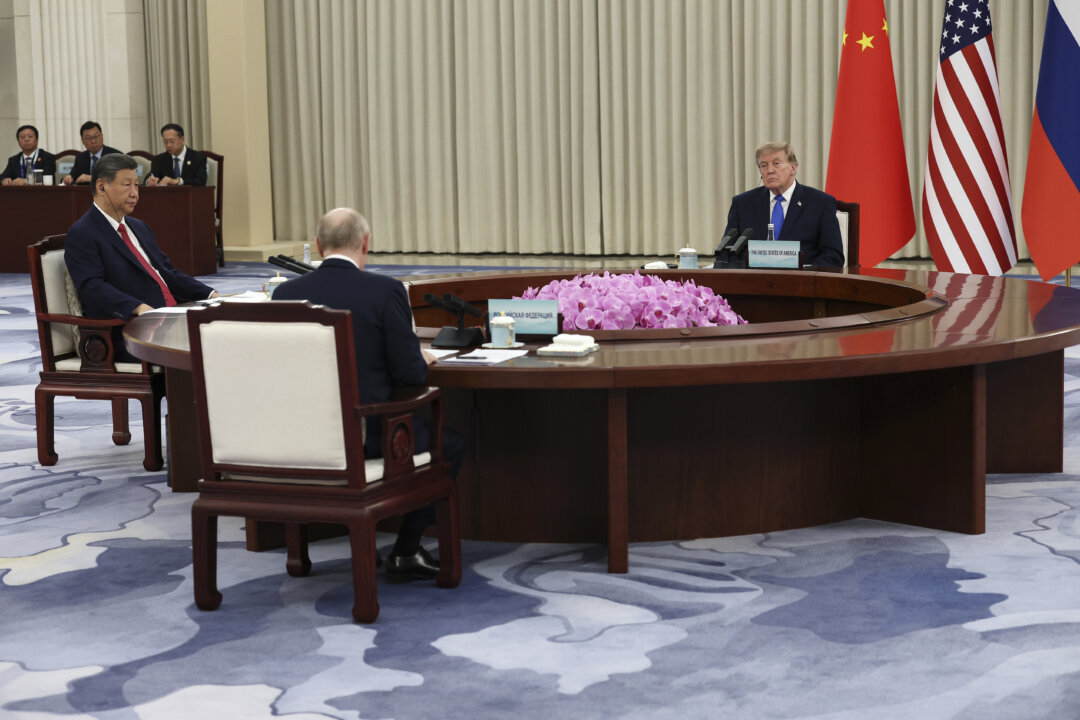
The first-ever trilateral summit between the leaders of the United States, China, and Russia
produced
a declaration that as largely symbolic, analysts said. The three countries remain deeply divided over nuclear weapons, the war in Ukraine, and regional security.
The Nov. 19 meeting in Shenzhen, China, between President Donald Trump, Chinese leader Xi Jinping, and Russian President Vladimir Putin ended with a four-point
declaration
in which the three leaders agreed to hold dialogue on reducing nuclear risks and preventing proliferation. It
offered
no concrete measures to resolve ongoing conflicts or achieve nuclear disarmament.
U.S.-based China current affairs commentator Wang He told The Epoch Times that, up until now, the Chinese Communist Party (CCP) has avoided taking part in nuclear weapons negotiations between the United States and Russia.
“It believes that its nuclear arsenal is far smaller than those of the United States and Russia, which together possess the overwhelming majority of the world’s nuclear weapons. It argues that the two countries have an obligation to negotiate first and reduce their arsenals,” Wang said.
The day after the trilateral, Trump said China is building nuclear weapons at a “hot and heavy” pace and could catch up to the United States in the next decade. The president estimated China had 600 nuclear weapons.
The United States has more than 3,700 nuclear warheads, according to the Energy Department, and Russia has 4,400 warheads, according to the Stockholm International Peace Research Institute.
Feng Chongyi, an associate professor of China Studies at the University of Technology Sydney in Australia, told The Epoch Times that the summit was primarily a political performance rather than a genuine agreement.
He said meaningful nuclear disarmament is unlikely.
“China’s strategy and America’s strategy are diametrically opposed. Neither side has room to retreat,” Feng said.
Canada-based Chinese pro-democracy activist and award-winning journalist Sheng Xue told The Epoch Times that the declaration’s vague language reflected the leaders’ inability to resolve their competing interests.
“This so-called peace declaration is very hollow. It avoids the sensitive issues that each side cares about. Saying they will hold dialogue on reducing nuclear risks and preventing nuclear proliferation is simply pushing the contradictions into the future,” Sheng said.
“The trilateral summit cannot change the structural confrontation between the free world and the authoritarian camp.”
Putin, Xi Seek Political Advantage
Sheng said Putin benefited from appearing alongside the U.S. and China leaders, using the meeting to demonstrate that Russia remains an international power despite its diplomatic isolation and growing economic dependence on Beijing.
She said the Russian leader also hopes to take advantage of Trump’s desire to end the Ukraine war to preserve territory Russia has seized and potentially obtain relief from U.S. sanctions.
Xi, meanwhile, needed the international exposure to portray China as an equal global power alongside the United States and Russia, Sheng said. Beijing also hopes to persuade Washington to ease pressure over tariffs, semiconductor restrictions, and AI development.
Feng also questioned Beijing’s claims to support peace, alleging that China has continued providing economic and strategic support to Iran while avoiding direct military assistance to prevent openly antagonizing Western countries.
Taiwan and Technology
The strategic disagreements also surfaced during Trump’s separate meeting with Xi on Nov. 19.
According to Chinese state news agency Xinhua, Xi emphasized Taiwan during the meeting, urging Washington to handle the issue appropriately to prevent major disruptions in bilateral relations.
Feng said the United States is unlikely to abandon its strategic position in the Indo-Pacific, while Beijing remains determined to bring Taiwan under its control and reduce American influence in the region.
Advanced semiconductors and artificial intelligence (AI) also remain contentious issues. Although Xi called for greater communication on AI security risks, analysts said the meeting was unlikely to resolve the underlying technology dispute.
Sun Kuo-hsiang, a professor in international affairs and business at Taiwan’s Nanhua University, told The Epoch Times that Washington and Beijing might establish communication channels or make limited adjustments in less-sensitive chip sectors, but are unlikely to remove restrictions on advanced AI chips.
Feng said the two countries
continued
competing through their respective leverage over semiconductors and rare earth minerals, even as their leaders publicly emphasized cooperation.
“The United States is squeezing the CCP through chips, while the CCP is squeezing the United States through rare earths,” Feng said.
“Because of their mutual dependence, neither side has completely broken ties. Instead, they keep talking empty words and pretending to be friendly.”
Tang Bing and Luo Ya contributed to this report.



2 Former Montreal Police Officers Charged with Assault and Criminal Harassment
An SPVM police shoulder patch is seen on an officer in Montreal,...
What the Data Show About the Reality of Canada-China Trade
A container ship unloads its cargo at Kwai Chung Container terminal in...
Chinese Rights Activist Detained After Publishing Account of Petitioners’ Removal From Beijing
A paramilitary guard stands at a security door inside the No. 1...
Chinese Family Planning Worker Says She Has Gone 3 Years Without Pay
A village family planning worker in eastern China says she has worked...