China’s Space Program Could Hand Its Military an Edge in Future Wars, Analysts Warn
 Jarvis LimUpdated 3 hours Ago3 Mins read
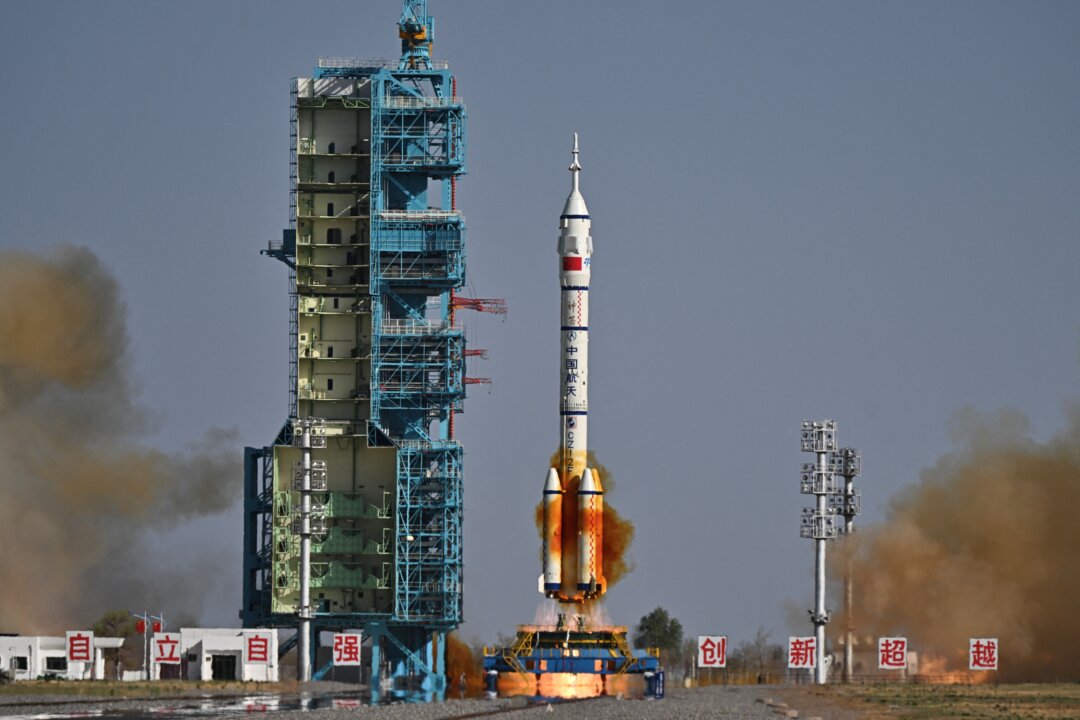
Beijing’s space program is closely tied to its armed forces and could feed military command and intelligence systems to gain an edge on future battlefields, experts warn.
China’s Shenzhou-24 spacecraft arrived at the Tiangong space station hours after liftoff on Nov. 25, according to Chinese state-run news agency Xinhua.
Three crew members were aboard the craft, including Pakistan’s Muhammad Zeeshan Ali, the first foreign astronaut to visit the station. He will carry out joint China-Pakistan space science experiments in orbit.
Ninety scientific experiments and technology tests are planned during the Shenzhou-24 mission, the China Manned Space Agency said on Nov. 24.
Mark Cao, a U.S.-based military tech analyst and host of the Chinese-language military news YouTube channel “Mark Space,” said these experiments may have no direct military use, but Beijing’s military-civil fusion policy ties the wider space program to the armed forces.
Military-civil fusion is a strategy under which the Chinese regime requires civilian technologies to also serve military purposes.
“Technologies such as satellites, robotic arms, and launch systems could serve both commercial and military purposes,” Cao told The Epoch Times.
Cao said the real worry for the United States is how far Beijing could take what it develops on its space station.
“China could gradually build an international space network in which other countries become increasingly dependent on Chinese technology, services, and standards,” he said.
Richard Chou Yu-ping, a member of the Evaluation Center Committee at Taiwan’s National Defense Industrial Development Foundation, said the know-how Beijing has gained through Tiangong could give its military a clearer picture of what is happening in orbit.
“For armed forces, keeping tabs on where enemy satellites are, how they’re operating, and any unusual moves is just as important as tracking the battlefield on the ground,” Chou told The Epoch Times.
“In future warfare, any information edge will likely rest on these space capabilities.”
Chou said linking Beijing’s space communications to the command and intelligence systems of the People’s Liberation Army (PLA) would speed up orders across the entire force.
New Model
Cao said Beijing’s choice of working with Pakistan highlights the close relationship between the two nations.
“Pakistan is the only country that has established a concrete partnership with China in the field of human spaceflight,” he said.
“China has also proposed jointly selecting and training astronauts with several Gulf countries, but these proposals have yet to receive an enthusiastic response.”

A family rides past a decoration depicting the flags of China and Pakistan ahead of the visit of Chinese Vice Premier He Lifeng, in Lahore, Pakistan, on July 30, 2023. Arif Ali/AFP via Getty Images
Chou said the arrangement is notable for its geopolitical impact on South Asia.
“India has been advancing its indigenous human spaceflight program, Gaganyaan, and joined the U.S.-led Artemis Accords,” he said.
“By offering space cooperation now, Beijing gives Pakistan a new foothold in South Asia’s tech race while cementing their long-term ties.”
The Artemis Accords,
launched
by the United States in 2020, set nonbinding principles for peaceful civil space exploration on the moon and beyond. India became the 27th country to sign on in June 2023.
Beijing and Islamabad have called each other “ironclad” friends, and both are
at odds
with New Delhi.
Pakistan fought a four-day military conflict with India in May 2025, the latest
flare-up
in their long-running dispute over Kashmir.
In June 2020, at least 20 Indian soldiers were killed in a
clash
with Chinese troops in the Galwan Valley, along the two countries’ contested Himalayan border.
Chou said the mission also shows Beijing is shifting focus from its Belt and Road Initiative (BRI)—an infrastructure mega-project analysts view as a tool for the regime to project global
influence
.
“BRI energy and infrastructure projects are prone to debt, political risks, and weak returns,” he said.
“Space cooperation ties partners to Beijing’s technology and talent for much longer.”
Chou said Pakistan is Beijing’s test case for a new model of international space partnership.
“If this model can be replicated across the Global South, Beijing could gradually build an alternative to the U.S.-led space system,” he said.
Countering Beijing
Cao said the regime’s space cooperation is not just about whether it can send more foreign astronauts into orbit but about gaining diplomatic clout and stronger political partnerships.
“By providing rockets, satellites, and astronaut training, China could establish technological ties with partner countries that last for decades,” he said.
Chou said Beijing’s push into the Global South poses a real challenge to Washington, one that military deterrence and technology curbs alone may not meet.
“If the United States wants to keep its lead in space, the key is deepening cooperation under the Artemis Accords,” he said.
“That would bring more countries on board, rather than keep the gains within a handful of high-tech powers.”
Chou said Washington can
counter
China and Russia’s push for their own space rules by rallying Europe, Japan, India, and other spacefaring nations behind practical norms.
“The bigger question is whether China can get its satellites, space station, and ground stations working together, not how advanced any one of them is,” he said.
“Washington’s coalition-building and China’s integration push are the key dynamics to watch in the U.S.-China space race.”






US Bars 2 Logistics Firms From USPS Over Counterfeit Postage on Packages From China
A federal court in Brooklyn on Nov. 25 permanently barred two U.S....

Taiwan’s Local Elections: 5 Things to Know About the China Factor
Nearly 19.6 million Taiwanese are eligible to vote for mayors and county...
Xi Jinping Accelerates Military Leadership Reshuffle Amid Expanding Purge
Chinese leader Xi Jinping is accelerating a reshuffle of the military’s top...
Analysts Welcome New Australia-Solomons Defence Pact, but Warn of Next Battleground
Security analysts have welcomed the Australia-Solomon Islands defence treaty but warned Beijing...