China’s Guangxi Tightens Controls on Grassroots Groups as Unpaid Wage Disputes Rise
 Michael ZhuangUpdated 1 day Ago3 Mins read
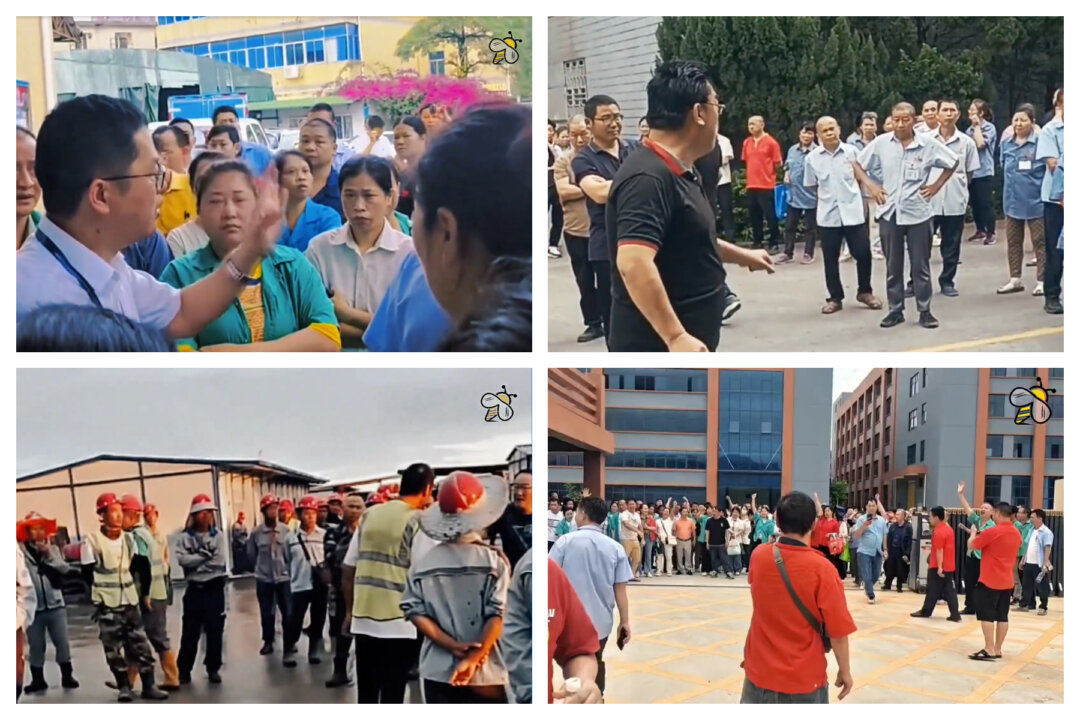
Authorities in China’s Guangxi Province are tightening controls over community organizations as state-owned enterprises lay off workers and disputes over unpaid wages become increasingly common, according to a local government official.
Unregistered community organizations have been ordered to register with the authorities, while registered organizations are being instructed to establish Chinese Communist Party (CCP) branches, according to an official within Guangxi’s civil affairs administration who spoke to The Epoch Times.
The official and other analysts spoke to The Epoch Times on condition of anonymity out of fear of reprisal.
The official said the measures were issued amid concerns that individual wage disputes and other rights-related complaints could develop into more widespread organized protests.
“Higher authorities have already issued a notice saying that the current situation is serious,” he said. “They want civil affairs departments to pay attention to community organizations.”
Workers in Guangxi and elsewhere in China have been facing mounting economic pressure. The reports, often quickly censored, are even reaching overseas. According to video footage posted on Sept. 20 by @whyyoutouzhele, a prominent Chinese citizen journalist account on X, several workers at Guangxi fire-protection contractor Yongda Fire Engineering Co. Ltd. held signs demanding they be paid outstanding wages.
The workers said seven people had been owed a total of more than 500,000 yuan ($74,680) in wages over nearly five years. They said repeated attempts to collect the money had failed.
The official said that rather than assisting parties to address the underlying grievances, authorities are increasingly focused on monitoring for organizations that may connect individuals with similar grievances.
Party Branches to Provide Oversight
An independent writer in Guangxi’s Beihai City told The Epoch Times that requiring community organizations to establish Party branches places them under closer political supervision, ensuring consistent political thought and loyalty toward the CCP.
The structure also requires organizations to disclose to authorities information about their members and activities, the writer said.
That structure, which runs a Party branch parallel to ordinary leadership, ensures consistent political thought and loyalty toward the CCP in otherwise independent organizations.
He also said that authorities are particularly concerned about disgruntled individuals using the internet to organize.
“The central authorities are most afraid that news of local incidents will spread across the country,” the writer said.
State Media Warnings
The extra controls in Guangxi coincide with a warning published in party media about the state’s growing difficulty in controlling online public opinion.
On Sept. 18, the official mouthpiece of the Central Party School of the CCP, Study Times, published a front-page policy essay titled “Improving the Ability to Guide Public Opinion and Handle Public Sentiment.”
The official party-approved commentary reported a profound change in China’s public-opinion environment and described it as a “high-risk flashpoint” for social conflicts. It said government at all levels faced serious challenges in responding.
The article highlighted internet platforms, saying that their algorithms now wield significant influence over agenda setting, information distribution, and the shaping of public sentiment.
It also highlighted the growing role of AI in producing and distributing information, as well as the continued flow of information from overseas into China’s censored online environment.
To date, the CCP has been able to maintain its control over information and public sentiment by censoring online content, suspending accounts, and using unified messaging in state media.
Study Times called for an upgrade of what it described as “emergency public-opinion management” and recommended incorporating it into a broader framework of national governance.
It also suggested that local governments first use measures such as “empathy” and “apologies” to ease public anger when dealing with public incidents, before gradually releasing information about what happened.
Growing Public Resentment
According to the writer, neighborhood grid workers—who are part of the CCP’s administrative mass surveillance system that divides urban and rural communities into small “grids” for managing political stability and social services—often go to residents’ homes to ask what difficulties they have.
“They are afraid that if small problems are not handled, they will become big problems. They want to eliminate conflicts in their early stages,” the writer said.
But according to a Guangxi-based human rights attorney surnamed Qin, local officials often lack effective ways to address the problems. Authorities then resort to using state power against people who raise complaints and rights defenders.
“The most common method is to prosecute them under vague charges,” Qin said. “This is not solving the problem at all, but deepening the conflict between the government and the people.”
Qin told The Epoch Times that worsening economic conditions and unresolved social conflicts are prompting more people to post videos online describing what they view as injustices.
“I believe these conflicts will eventually erupt on a large scale,” he said.
He said the recommendation by Study Times that officials use “empathy” and “apologies” to defuse public anger amounted to an acknowledgment that previous responses had often failed to address the sources of public dissatisfaction.
Ye Zilong contributed to this report.







Families Call for Release of Loved Ones in China as Xi Visits US
WASHINGTON—These are the faces that Beijing doesn’t want the world to see.They...

Xi Seeks Trade and Technology Concessions From Trump Ahead of Summit
Chinese leader Xi Jinping is seeking concessions from President Donald Trump on...

Defence Urges Delay on Sexual Assault Reform as Veterans Say Victims Can’t Wait
The Department of Defence wants Parliament to delay creating an independent body...

Australia Has ‘More or Less Done Nothing’ on Organ Trafficking: Human Rights Lawyer
SYDNEY—Australia is failing to do enough to combat overseas organ trafficking, Canadian...