
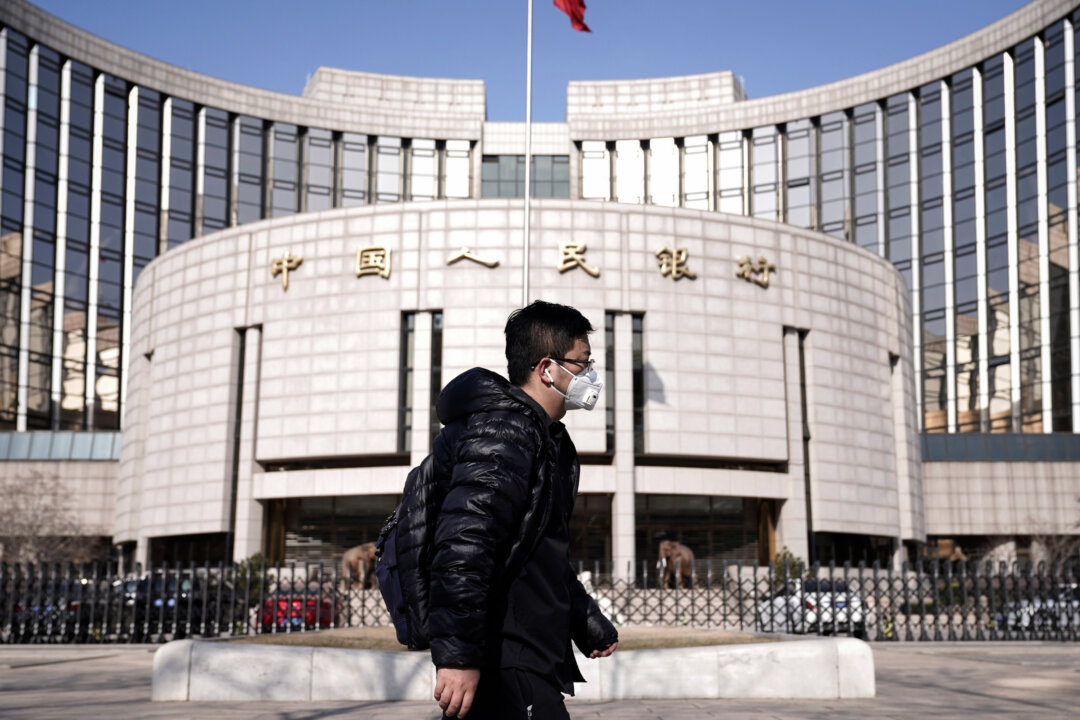

China’s state-owned banks have cut employee pay for a third consecutive year as loan growth continues to slow and household borrowing contracts, according to employees at two major lenders who say frontline staff are increasingly bearing the cost of Beijing’s efforts to prop up the economy.
The employees told The Epoch Times that salaries, bonuses, and benefits have been steadily reduced while banks remain under pressure from the Chinese regime to support the struggling property sector, help refinance local government debt, and expand policy-driven lending despite weak credit demand. They spoke on condition of anonymity out of fear of reprisal.
Official data released by China’s central bank on July 15 showed new yuan-denominated loans totaled 10.72 trillion yuan ($1.58 trillion) in the first half of the year, about 2.2 trillion yuan ($330 billion) less than a year earlier. Outstanding yuan loans grew 5.2 percent year over year.
Household borrowing continued to weaken. Household loans fell by 366.8 billion yuan ($54 billion) during the first six months of the year, including a 588.1 billion yuan ($87 billion) decline in short-term household loans, indicating continued weakness in home purchases, consumer spending, and personal borrowing.
Pay Cuts at Major Chinese Banks
An employee at one of China’s state-owned banks, surnamed Fang, told The Epoch Times the country’s four largest lenders have implemented three rounds of pay cuts over the past three years.
“The first cut was about 20 percent, followed by another 10 percent. Then in March this year, salaries were cut by another 10 percent,” he said. “In the past, banks also provided various employee benefits and allowances. Most of those have now been canceled.”
The four state-owned banks he referred to are the Industrial and Commercial Bank of China, Agricultural Bank of China, Bank of China, and China Construction Bank. Fang declined to identify his employer or branch location because he feared internal retaliation.
The Epoch Times reached out to the four banks but did not receive a response by publication time.
According to Fang, the reductions extend beyond salaries.
“In the past, branch offices could keep part of the revenue generated from the loans they originated and use some of it to pay year-end bonuses,” he said.
“Now all of that money has to be turned over to headquarters. Branches no longer have discretionary funds, so the bonuses are gone.”
Fang attributed the compensation cuts to rising bad loans and weakening lending activity.
“Over the past three years, household lending has fallen by around 30 to 40 percent each year. In the first half of this year, it was down another 40 percent from a year earlier. Some banks have seen even bigger declines. Those are internal figures,” he said.
Compensation at China’s state-owned banks typically includes base salary, performance-based pay, business bonuses, and various allowances. Fang said recent adjustments have mainly affected performance pay, bonuses, and benefits rather than base salaries. However, after three consecutive rounds of cuts, employees’ take-home pay has declined significantly.
Lending Targets Remain Despite Weak Demand
Despite weakening credit demand, Beijing continues to pressure state-owned banks to increase lending.
Citing anonymous sources, Reuters reported in May that China’s central bank had instructed several large state-owned banks to expand lending, even as demand for household and business borrowing remained weak. At the time, new yuan loans fell by 10 billion yuan ($1.5 billion) in April, marking the first monthly contraction in nine months, while household loans declined by 786.9 billion yuan ($116.3 billion).
An employee in the lending department at an Agricultural Bank of China branch, surnamed Zhang, told The Epoch Times that the bank continues to assign annual lending quotas to branches, and that employees face cuts to performance bonuses if the targets are missed.
“The lending targets keep coming down from the bank’s headquarters, but there simply aren’t enough qualified borrowers who actually want loans,” Zhang said.
“Companies that have the ability to repay don’t want to expand investment, while small and medium-sized businesses that need financing often can’t meet the banks’ risk-control requirements.”
As a result, frontline employees are under growing pressure to find borrowers.
“We have to look everywhere for customers and even pay for client entertainment out of our own pockets,” he said.
“Loan interest rates are already very low, and many loans generate almost no profit. Some employees would rather not make the loans because the returns are so small. It’s not our money that’s being lost. We’re just suffering through it.”
Chinese central bank governor Pan Gongsheng has argued that slower loan growth reflects changes in corporate financing rather than weakening economic activity, saying more companies are raising capital through bond and equity markets rather than bank loans, according to Chinese state media Economics Daily.
However, China’s prolonged property downturn, weak consumer spending, and subdued private-sector investment continue to suppress demand for bank credit. In 2025, new bank lending fell to 16.27 trillion yuan ($2.4 trillion), the lowest level in seven years, according to data cited by Chinese state media Xinhua News Agency.
The central bank’s financial statistics for the first half of 2026 showed that loans to businesses and public institutions increased by 11.13 trillion yuan ($1.64 trillion), including 4.59 trillion yuan ($680 billion) in short-term loans, 5.55 trillion yuan ($820 billion) in medium- and long-term loans, and 814.3 billion yuan ($120.35 billion) in bill financing.
Zhang said bill financing is commonly used within China’s banking industry to help banks meet lending targets when genuine loan demand is weak.
“Some of the data released by the central bank is meant to support the regime’s broader economic narrative,” he said.
“It has to match the official picture of economic growth, so it’s hard to believe the figures fully reflect reality.”
He added that some municipal-level secondary branches had issued only a few hundred million yuan in new loans during the first half of the year, but declined to identify the locations.
The accounts from Fang and Zhang suggest that the burden of sustaining Beijing’s lending goals is increasingly falling on bank employees through lower pay, shrinking bonuses, and mounting pressure to originate loans despite weak demand.
Wu Ting contributed to this report.