

Chinese firms’ illicit recruitment in Taiwan signals Beijing’s push to penetrate the island’s technology sector, experts warn, but the approach is unlikely to yield the innovation needed to overtake U.S. tech.
Taiwan’s Ministry of Justice Investigation Bureau announced on Aug. 5 that it uncovered 17 Chinese companies illegally poaching high-tech talent in Taiwan between July 13 and Aug. 4.
The implicated firms span industries including semiconductors, integrated circuit (IC) design, display chips, composite materials, and battery manufacturing.
Many of them are publicly listed in China or hold significant global market shares, including carbon fiber maker AoSheng Hi-Tech, IC designer Goke Microelectronics, and consumer-battery supplier Zhuhai CosMX Battery.
Goke Microelectronics was blacklisted by the U.S. Commerce Department in 2021 for “supporting the military modernization of the People’s Liberation Army.”
These companies evaded detection by masquerading as local or foreign-invested businesses, setting up unauthorized hubs, or using manpower agencies for fake employee dispatches, the bureau said.
Authorities have cracked more than 100 similar espionage cases since launching a dedicated task force in 2020.
Taiwan is a global semiconductor powerhouse.
It’s home to Taiwan Semiconductor Manufacturing Co. (TSMC), the world’s
manufacturer of advanced artificial intelligence (AI) chips.
The island’s technological edge makes it a prime target for
by the Chinese Communist Party (CCP), which has vowed to annex the self-governed democracy—by force if necessary—despite never having ruled it.
The poaching comes as Washington continues to
regulations and export controls to block the regime’s access to advanced AI equipment, robotics, and optical communication products.
‘Technological Espionage’
Lee Chung-chih, deputy convenor of the Strategic Industries Program at Taiwanese think tank the DIMEs Center, said these firms have been building covert networks across Taiwan to circumvent
.
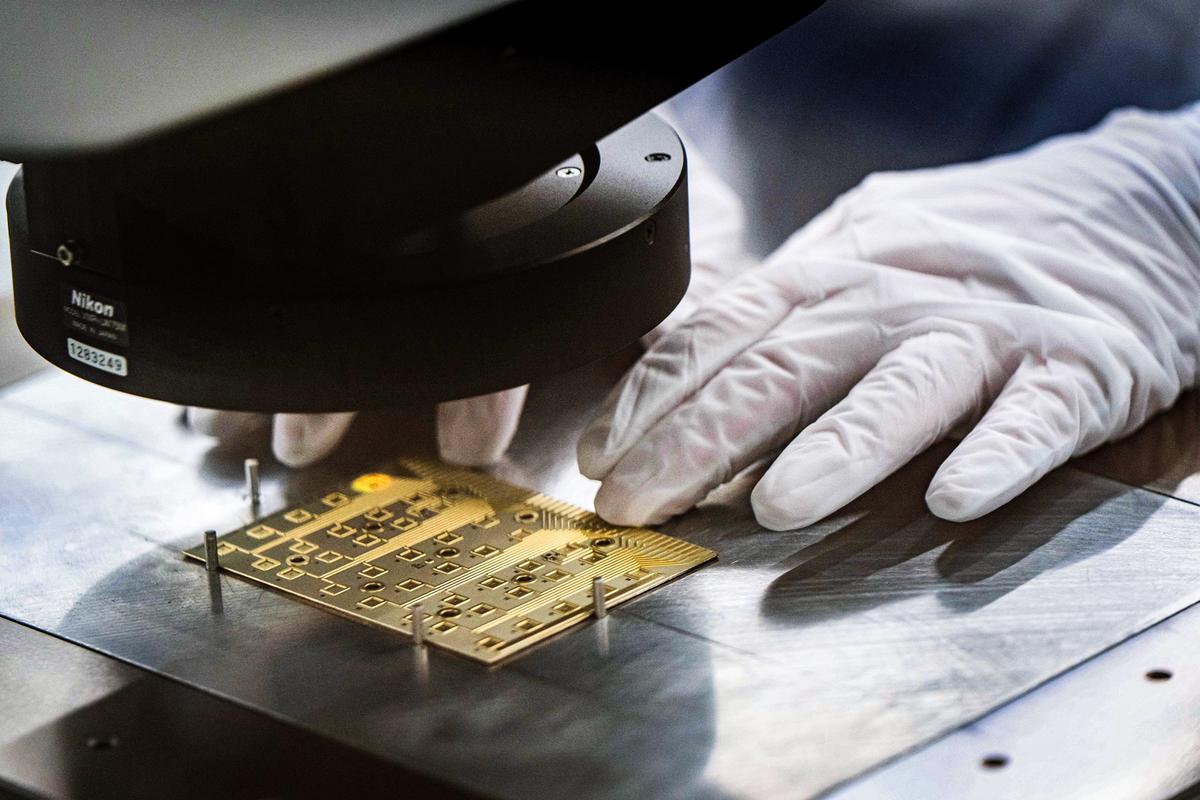
A worker conducts testing in a Coherent manufacturing facility where lasers are developed for transmitting data among chips, which could decrease power use by AI systems, in Sherman, Texas, on June 16, 2026. Jeffrey McWhorter/AP Photo
“This shows they are using ‘technological espionage’ to deeply infiltrate Taiwan’s technology sector,” Lee told The Epoch Times.
“Once they gain control of Taiwan’s tech supply chains, they can obtain critical information as Washington steps up its efforts to curb the regime’s access to advanced technology.”
Lin Tsung-nan, a professor of electrical engineering at National Taiwan University, said such activities are likely tied to “
“—an ambitious plan to dominate global advanced manufacturing—suggesting Chinese firms are resorting to illicit means to advance Beijing’s semiconductor industry.
“Chinese companies cannot invest in Taiwan’s tech firms without authorization, so they pose as foreign investors to address China’s shortage of semiconductor talent,” Lin told The Epoch Times.
Lin said the CCP may not have issued direct orders, but it undoubtedly drives these tech firms with immense pressure and state incentives.
“The theft case involving ASML shows that Chinese semiconductor manufacturers will stop at nothing to secure subsidies from their government,” he said.
ASML, a semiconductor equipment maker based in the Netherlands, accused XTAL of stealing trade secrets in 2019. California-based XTAL was founded by two Chinese engineers who were former ASML employees and the company had ties to the Chinese regime, according to Dutch newspaper Het Financieele Dagblad.
A U.S. court ordered XTAL to pay ASML $845 million in damages that year, after which XTAL filed for bankruptcy.
Taiwan’s Tech at Risk
Lee said Chinese campaigns to infiltrate the local tech industry present a “massive crisis” for Taiwan’s technological resilience, but they will not immediately topple its global
.
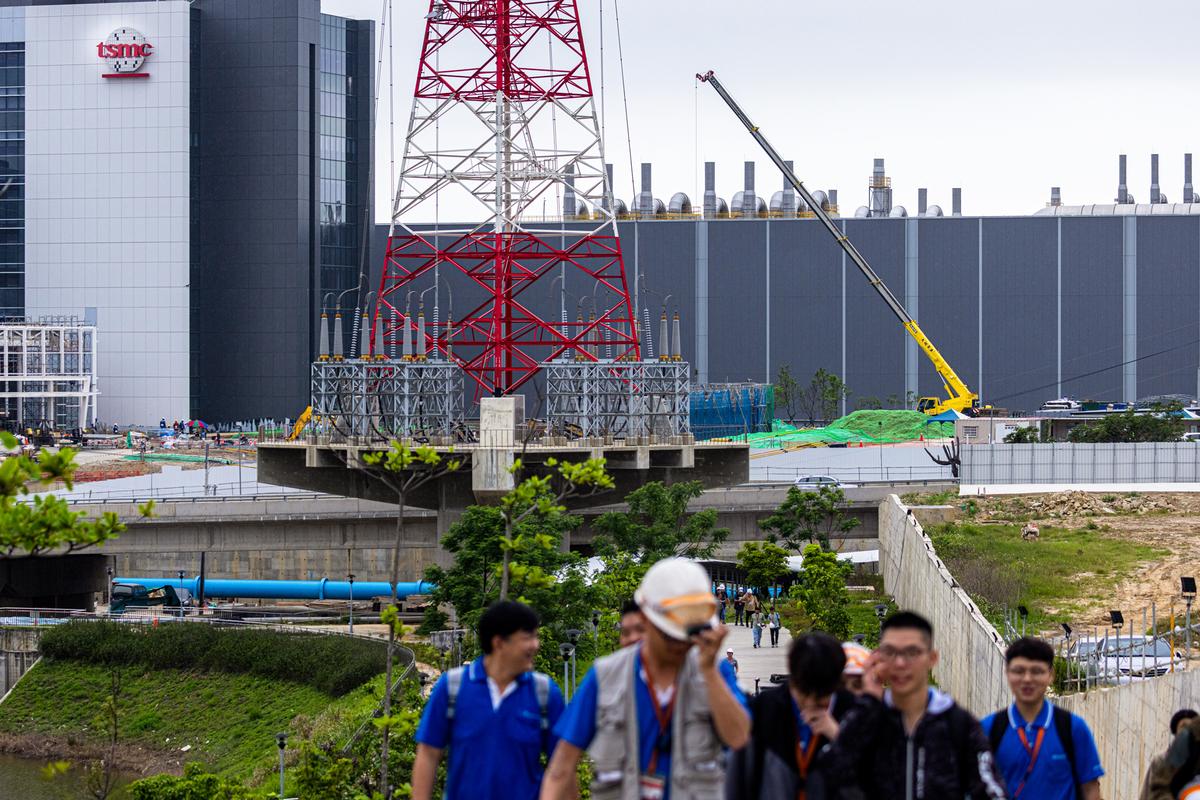
A Taiwan Semiconductor Manufacturing Co. Ltd. (TSMC) building is seen in the background at Hsinchu Science Park in Hsinchu, Taiwan, on April 18, 2025. Annabelle Chih/Getty Images
“Taiwan’s semiconductor sector boasts a complete supply chain and formidable mass-production capabilities,” he said.
“China lacks sufficient innovation mechanisms, and dismantling this industry would demand immense effort and cost.”
Still, Lee warned that if the CCP leverages these operations to extract industry intelligence, it could gain an unfair advantage in future tech products and erode Taiwan’s edge—a threat Taipei must guard against.
If Beijing cannot win the semiconductor race, it will use stolen insights to monopolize future tech markets,” he said.
“It could potentially render the island’s current dominance irrelevant.”
Benefits and Limits
Lin said Beijing is benefiting from the illegal recruitment.
“Even TSMC has suffered trade-secret theft, showing that Taiwan’s technology companies remain vulnerable whenever criminals have sufficient financial incentives,” he said.
“Each breach may seem minor, but together they could give Chinese companies access to advanced technologies.”
The TSMC logo is displayed on a building in Hsinchu, Taiwan, on April 15, 2025. Ann Wang/Reuters
In August 2025, Taiwanese prosecutors
several individuals for allegedly stealing TSMC trade secrets for the benefit of Tokyo Electron, a Japanese chipmaking equipment supplier.
In April, a court announced prison sentences for those involved and a NT$150 million ($4.7 million) fine for Tokyo Electron.
Lin added that while direct U.S. restrictions remain effective, Beijing is
enforcement gaps among Washington’s partners.
“The Netherlands, Japan, and Taiwan have not fully aligned with U.S. controls, limiting Washington’s efforts to curb China’s technological development,” he said.
Lee, however, said that such espionage has its limits.
“Genuine high-tech export restrictions are far more stringent than what Taiwanese authorities can realistically investigate,” he said.
“Such activities may give China a breakthrough in a specific technology, but an entire technological ecosystem cannot be copied or stolen.”
Lee said Beijing faces deep-rooted obstacles to securing a long-term foothold in the tech sector, regardless of any attempts to bypass foreign curbs.
“These constraints stem directly from the Chinese regime itself, driven by a severe deficit in basic scientific research and creativity,” he said.
“This is a sweeping institutional failure. Under the CCP’s authoritarian control, there is simply no space for the freedom required to innovate.”