Mecca Defense Pact Not Aimed at Iran: Erdogan
 Evgenia FilimianovaUpdated 3 hours Ago3 Mins read
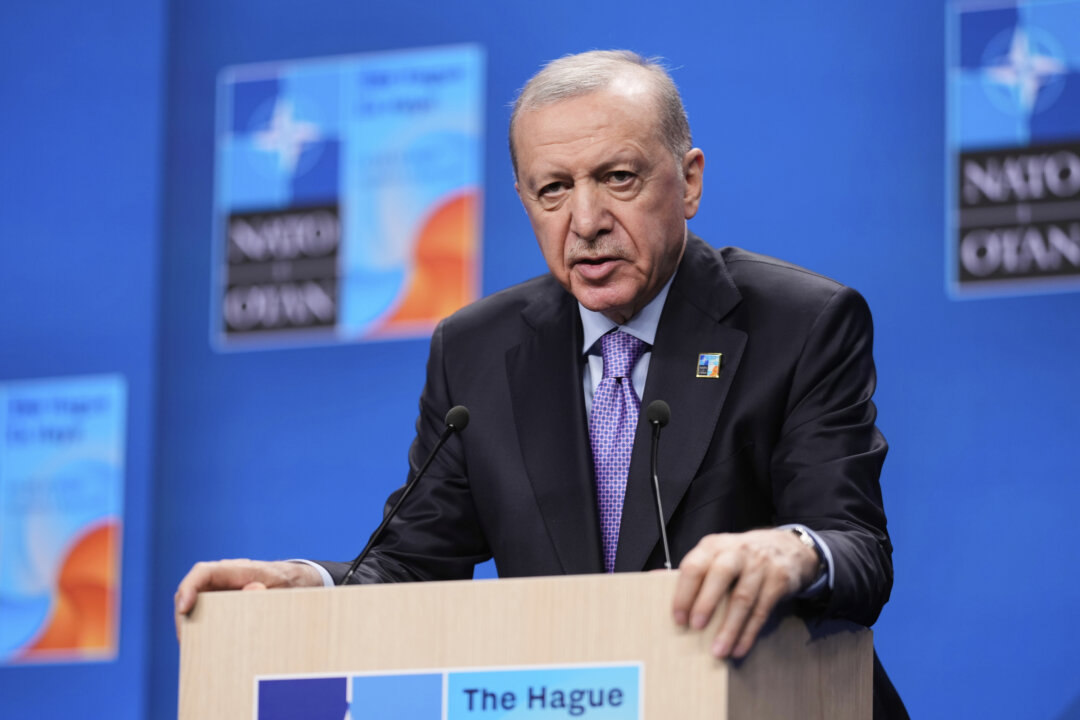
Turkish President Recep Tayyip Erdogan said that the Mecca Joint Defence Agreement, a mutual defense pact between Turkey, Saudi Arabia, and Pakistan, is not directed against Iran, Israel, or any other country.
The three countries signed the agreement in August. It stipulates that an armed attack against any of the three would be regarded as an attack on all.
Saudi Arabia is the Gulf’s largest military spender, Turkey has NATO’s second-largest army after the United States, and Pakistan is the world’s only nuclear-armed Muslim-majority nation.
Erdogan told Newsweek in a Sept. 25 interview that the Mecca agreement is not positioned against any third country. The U.S.–Iran conflict could be resolved only through negotiations, he said, urging both sides to avoid further escalation.
“The United States is our ally within NATO. Iran is our neighbor,” he said, adding that he has maintained open communication with both U.S. President Donald Trump and Iranian officials.
Any response under the Mecca pact, Erdogan said, would depend on the attacked country’s needs and could include intelligence, logistics, or ammunition support.
The Turkish president also said the alliance would decide any response on a case-by-case basis.
“It would not be right at this stage to envisage an automatic military response scenario for every incident that may occur in Iraq, Yemen or elsewhere,” he told the news magazine.
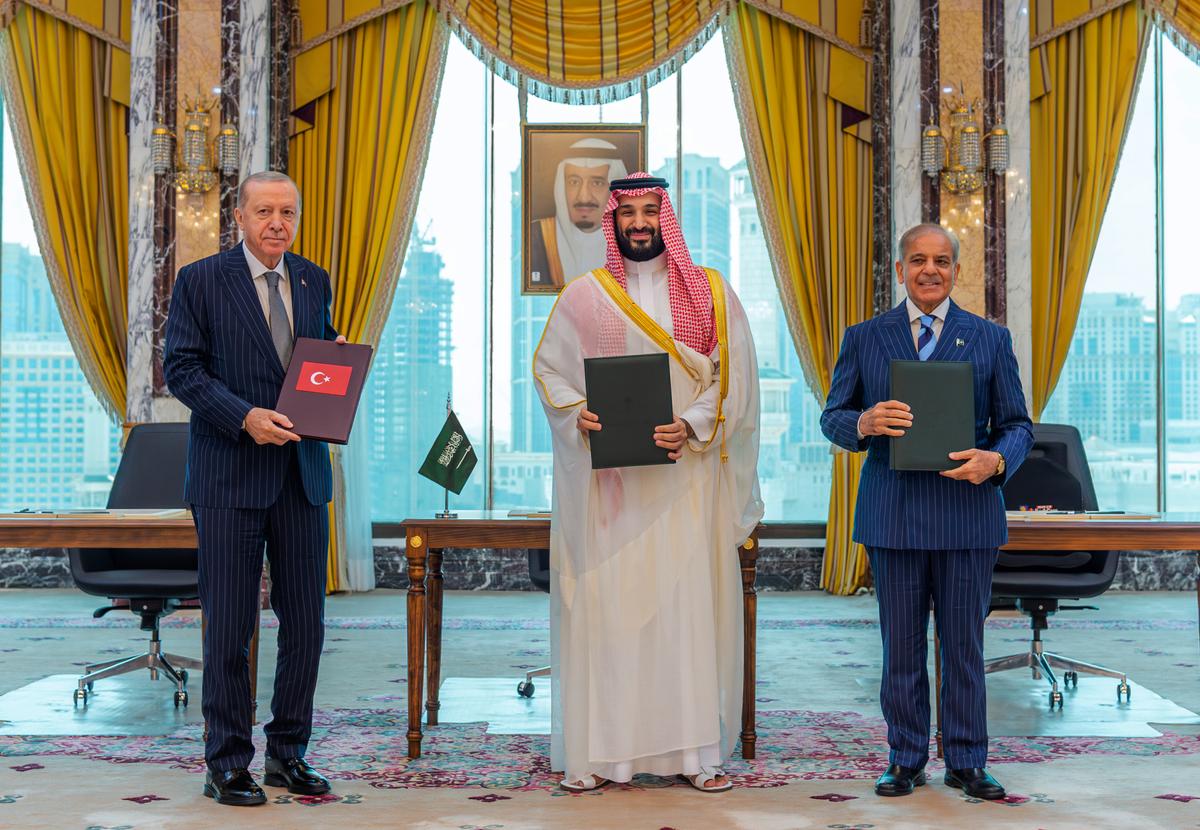
Turkish President Recep Tayyip Erdogan (L), Saudi Crown Prince Mohammed bin Salman (C), and Pakistani Prime Minister Shehbaz Sharif (R) in Mecca, Saudi Arabia, on Aug. 7, 2026. Saudi Press Agency/AP
The comments come as the Iran-backed Houthi terrorist organization in Yemen has in recent weeks made advances in the Red Sea and exchanged military attacks with Saudi Arabia.
Saudi military spokesman Maj. Gen. Turki Al-Malki said on Sept. 19 that the Saudi forces intercepted a ballistic missile targeting Riyadh and thwarted attacks on four Saudi cities of Baish, Taif, Farasan, and Yanbu.
Taif and Yanbu were again targeted on Thursday, Al-Maliki said in a post on X.
“Escalations and violations by the terrorist Houthi militia will be dealt with firmly,” he added in a follow-up post.
Yahya Saree, a Houthi military spokesman, said in a Sept. 24 post on X that Saudi forces had conducted 1,018 airstrikes and missile attacks between what he described as the beginning of escalation and Thursday evening.
Last week, Turkish Foreign Minister Hakan Fidan told Turkish broadcaster NTV that Ankara was ready to provide technical military assistance to Saudi Arabia under the Mecca agreement if the kingdom requests it.
Pact Could Expand
Turkish Parliament Speaker Numan Kurtulmus said on Sept. 25 that the Mecca agreement could eventually include other countries in the Muslim world, including Iran.
“The Mecca Agreement should, perhaps through its expansion, become an agreement that will ensure the security of the countries of the region, and, in a broader sense, of the Islamic world, with the participation of Iran and perhaps other regional countries as well,” Kurtulmus added.

Turkish Parliament Speaker Numan Kurtulmus attends a meeting with the Russian president at the Kremlin in Moscow on Sept. 25, 2024. Maxim Shemetov/AFP via Getty Images
The pact remains in its early stages as Turkish lawmakers are yet to approve the proposal. Kurtulmus said he expects the matter to reach the Turkish parliament’s agenda soon after the legislature reconvenes on Oct. 1.
Pakistan
Pakistani Prime Minister Shehbaz Sharif condemned the Houthi attacks on Saudi Arabia in a Sept. 23 post on X, calling a drone strike aimed at Mecca a direct threat to Islam’s holiest sites.

Pakistani Prime Minister Shehbaz Sharif (C) arrives during the 81st United Nations General Assembly at the United Nations Headquarters in New York on Sept. 22, 2026. Charly Triballeau/AFP via Getty Images
Sharif met separately with Iranian President Masoud Pezeshkian on the sidelines of the U.N. General Assembly in New York this week, where the two leaders discussed the broader regional conflict.
He said he urged restraint and diplomacy while reaffirming Pakistan’s ties with Tehran.
Pakistan hosted U.S.–Iran talks in April and later acted as witness and mediator when the Islamabad Memorandum of Understanding (MOU) was signed in June.
Although the deal collapsed the following month, Sharif said Pakistan remains committed to building on it to achieve regional peace and stability.




Afternoon front page: CBC journalist disciplined over post on anti-Israel protest; synagogue attacker sued military over COVID vaccine mandate; and more
An image from Neil Herland's video shows protesters outside the Meridian Arts...
Scott Stinson: Doug Ford’s love affair with corporate subsidies shows no sign of waning
Ontario Premier Doug Ford speaks to reporters outside his office at Queen's...
Michigan CEO who posted ‘Lake America’ sweatshirt photo no longer with company
A map showing Lake Ontario as "Lake America" displayed as U.S. President...
What makes a good leader? Authors Jody Wilson-Raybould and Roshan Danesh can explain
Article content“It crystallized a lot when I was sitting around the Cabinet...