France’s Top Literary Prize Drops Novel Over AI and Plagiarism Claims
 Owen EvansUpdated 4 hours Ago3 Mins read
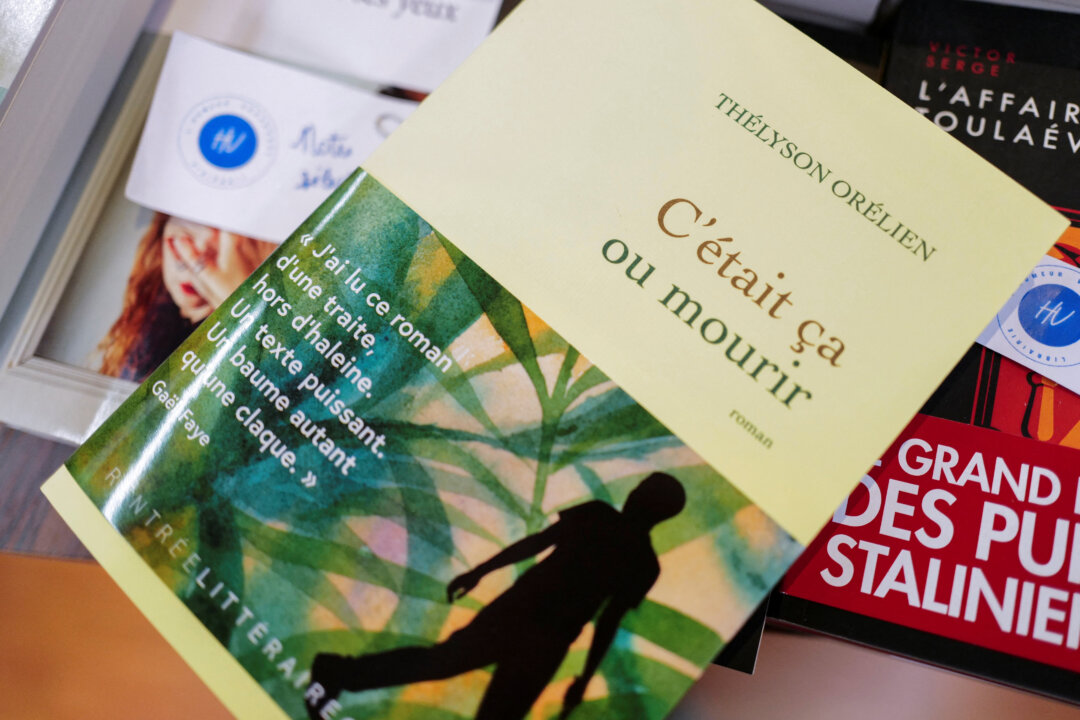
France’s Académie Goncourt on Friday removed Canadian Haitian writer Thélyson Orélien’s debut novel from its longlist, citing plagiarism allegations and findings that the book was “in all likelihood, very largely the product of artificial intelligence.”
The decision from the Goncourt, France’s oldest and best-known literary prize, comes days after an anonymous X account accused the novel of being AI-generated.
The book, “C’était ça ou mourir” (It Was Either That or Die) by the Québécois writer of Haitian origin, had been one of the season’s French-language hits, winning multiple prizes.
In a statement on Sept. 25, the academy said it acted “to preserve the integrity of the Prix Goncourt and that of the Academy, whose central role is to promote and honour literature written by women and men.”
It pointed to “plagiarisms of which its author has been guilty over time and which have just been revealed,” as well as “the convergent findings of several analyses by researchers and journalists of good faith.”
The withdrawal, it said, was meant “to send a clear message” that the academy does “not endorse or sanction in any way the creation of texts generated with the help of AI.”
The controversy began on Sept. 21 when the X account Balance Ton Claude said the detection tool Pangram had flagged passages throughout the manuscript as “100 percent AI.”
The account said it tested several excerpts “at various points in the manuscript, and got almost always the same result.”
It also said that four texts Orélien wrote in 2014 received an AI score of zero percent on the same tool.
Essayist Samuel Fitoussi later claimed ownership of the account, saying he managed it with other unidentified individuals.
“To all those who accuse us of harming Orélien, consider instead the author who spent hundreds of hours on his manuscript to write a magnificent book, one that deserved the Goncourt Prize, and which he didn’t win,” he wrote in a Sept. 25 post on X.
“Although rather techno-optimistic, I fear that after several millennia of civilization based on writing, AI will cause the disappearance of reading and writing.”
On Sept. 23, Radio-Canada claimed that at “least five columns and opinion pieces” published by Orélien in Canadian and French media in 2012 and 2013 were partly copied from the texts of other authors.
On Sept. 23, in a statement sent to French newspaper La Presse, where Orélien sometimes wrote, Les Éditions du Boréal, Orélien’s French Canadian publisher, reiterated its support for the author.
“These statements are very serious and directly damage the author’s reputation,” it said.
Boréal said that Orélien completed the first draft of his novel several years ago, and the text “then matured over the course of many round trips with its editor, as evidenced by the successive versions of the manuscript up to its final form.”
“This editorial work was carried out with the utmost rigor, without any intervention from the AI,” it added.
However, on Thursday, Boréal told Radio-Canada it had now suspended the promotional activities surrounding the book.
“Unfortunately, it is impossible for us at this stage to overturn or confirm the allegations that the author is facing,” it said.
A statement circulated by his French publisher, Éditions Grasset, on Sept. 22 to AFP, and reported in Le Figaro, said that the “malicious” comments about AI have “hurt the writer terribly with an exceptional career.”
The debut novel tells the story of a Haitian immigrant who travels north through Latin America before ending up in Canada.
“In the United States, he encounters the brutality of ICE, a symbol of a system opposed to immigrants,” said Fnac, France’s big cultural retailer, in a review of the book.
Orélien has denied the accusations and attributed the book’s repetitions to “Haitian and Caribbean literary tradition where poetry, images, repetitions and rhythm carry a living word.”
“It is in this heritage that my voice was built,” he said in a statement sent to FranceInfo on Sept. 22.
The Epoch Times has contacted Éditions Grasse and Les Éditions du Boréal for comment.







Afternoon front page: CBC journalist disciplined over post on anti-Israel protest; synagogue attacker sued military over COVID vaccine mandate; and more
An image from Neil Herland's video shows protesters outside the Meridian Arts...

Scott Stinson: Doug Ford’s love affair with corporate subsidies shows no sign of waning
Ontario Premier Doug Ford speaks to reporters outside his office at Queen's...
Michigan CEO who posted ‘Lake America’ sweatshirt photo no longer with company
A map showing Lake Ontario as "Lake America" displayed as U.S. President...

What makes a good leader? Authors Jody Wilson-Raybould and Roshan Danesh can explain
Article content“It crystallized a lot when I was sitting around the Cabinet...