
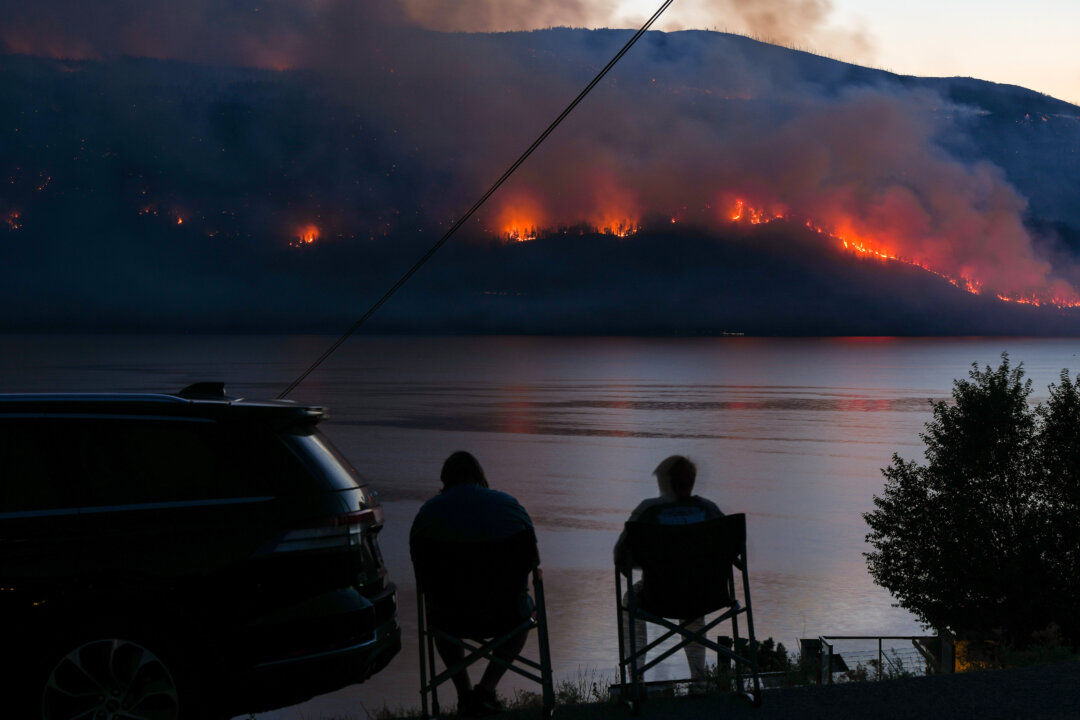

People watch as the Quilpituk Creek wildfire burns on the mountainside across Okanagan Lake, in Lake Country, B.C., on Aug. 3, 2026. The Canadian Press/Darryl Dyck
Commentary
Once again, dried out forests, brush, and timber are bursting into flames in regions across Canada, devastating areas including in British Columbia’s Okanagan Valley, and causing a distressing amount of harm to people, property, livelihoods, and cherished environments, both natural and man-made.
Unfortunately, Canada is also enmeshed in another destructive cycle of policy argumentation over how we, as a society, can manage the risks. Specifically, policymakers and pundits are arguing about who can most aggressively regulate nature with controlled burns of fire-ripe forests or rapid dousing of flareups in certain areas.
Now, you can argue that Canada could better manage wildfire risk through better and more aggressive use of controlled burning, an ancient practice that became less fashionable over the years. Since 1990, the area treated with prescribed burning in Canada fell from more than 35,000 hectares to just 182 hectares in 2023—a 99.5 percent decline. That’s a lot less control. And higher levels of fire-management via controlled burning might mitigate some risk, particularly in areas near people.
But while controlling forest fuel helps, governments and societies simply can’t or won’t do this effectively or sustainably. Forests are not voting blocs, nor are they constituent groups subject to the blandishments of politicians or the management of bureaucrats. So instead of rehashing old arguments about controlling nature, we should focus on asking how Canadians (and people worldwide) can better adapt to destructive natural phenomena such as fires in the summer. That means asking hard questions to find solutions.
For example: How do we disincentivize people from placing valuable property into high-risk environments? Should governments allow people to use (for recreation or other activities) areas that are repeatedly vulnerable to fire risk? How do we structure society’s economic instruments (insurance, for example) to optimally protect people and infrastructure in certain areas? Would ensuring risk-based fire-insurance, for example, change people’s willingness to build in harm’s way? Do we allow rebuilding in fire-vulnerable places after fire takes a home or business? And do Canadian building codes require some attention, as California’s did after the major earthquakes of the 1970s? After repeated fires, do we still allow wood construction?
On the ground, there are more questions. How can we use technology to mitigate human risk in fire prevention and firefighting? Do we need better fire detection and warning systems and expanded emergency shelter capacity? Can we make more and better use of air-quality detection and warning systems? (India, for example, has helped mitigate heat-wave risk to humans through detection and warning systems, along with public facilities to shelter the most vulnerable people at peak risk.) Surely, AI experts in Canada could play a key role in developing these technologies.
The priority must be people. Victims of fires, in the Okanagan Valley and everywhere else in Canada, this year and in years past, deserve our empathy, compassion, and support. Helping victims is a moral imperative. But so is learning from the past, and the old adage—that the definition of insanity is continuously doing the same thing but expecting different outcomes—is more than apt when it comes to wildfires in Canada.
Once again, Canadians are asking the same question: How do we prevent our natural environment from bursting into flames every year? And once again, we’re dodging a central question: How can we better adapt to that natural environment?
Kenneth Green is a senior fellow at the Fraser Institute.
Views expressed in this article are opinions of the author and do not necessarily reflect the views of The Epoch Times.