RCAF Receives New Training Planes As Transition Officially Begins Away from Tutor Jets
 Jason G. AntonioUpdated 2 hours Ago2 Mins read
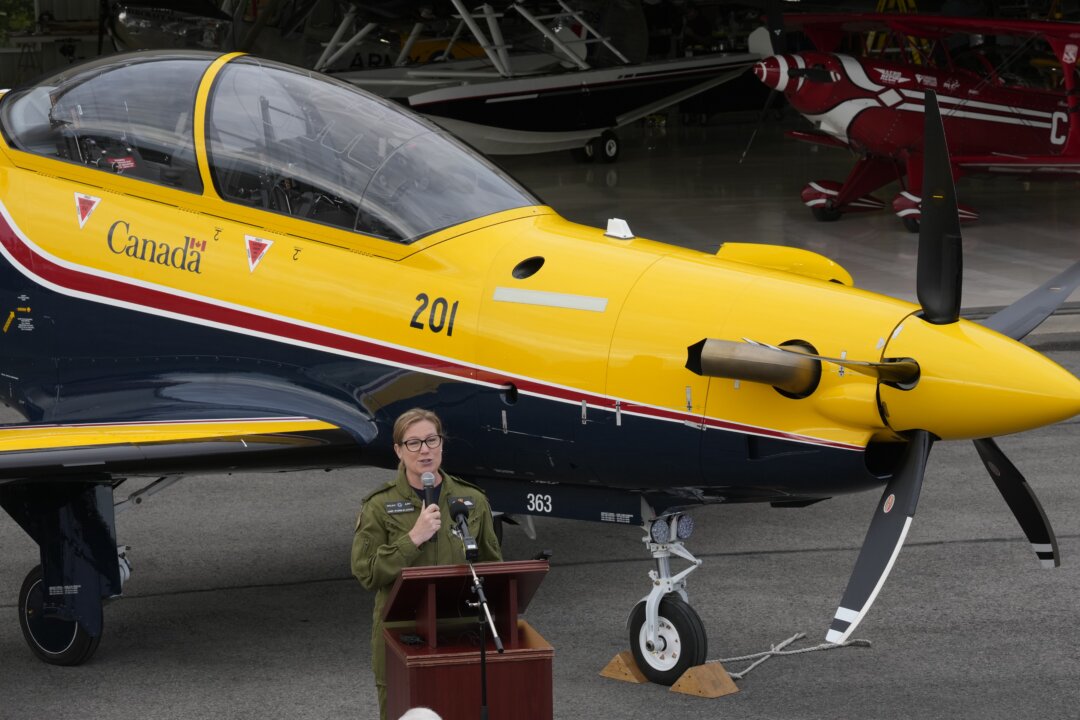

Royal Canadian Air Force commander Lieutenant-General Jamie Speiser-Blanchet speaks during an event introducing the Pilatus CT-157 Siskin II training aircraft in Gatineau, Que., on Sept.17, 2026. The Canadian Press/Adrian Wyld
The Royal Canadian Air Force has received its first two Siskin II planes, marking the start of a transition to the turboprop aircraft that will replace the Tutor jets flown by the Snowbirds aerobatics team.
The RCAF officially accepted the two CT-157 Siskin II (Pilatus PC-21) aircraft on Sept. 17, after their trans-Atlantic flight from the Pilatus factory in Switzerland, the air force announced. The aircraft are the first of a 19-aircraft fleet that will operate as part of the $11.2 billion Future Aircrew Training program (FAcT) and will be based at 15 Wing Moose Jaw, Sask.
“A proven trainer used worldwide by partner and allied air forces, the Siskin II will provide future pilots with a sophisticated, high-performance training platform to prepare them for the advanced aircraft they will fly throughout their careers,” the RCAF wrote on social media.
“Upon arrival in Moose Jaw, these aircraft will next be used in a train-the-trainer and course development role.”
The turboprop-powered Siskins will eventually be used for advanced fixed-wing and jet-oriented pilot training. The government has also announced plans to procure the Siskin II for the future Snowbirds team, which will replace the Canadair CT-114 Tutor aircraft currently flown by the aerobatics team.
The federal government announced in May that it was retiring the Tutor fleet at the end of the 2026 season, placing the Snowbirds on an extended hiatus until the Siskins are fully operational in the early 2030s.
RCAF Commander Lt.-Gen. Jamie Speiser-Blanchet said at a Sept. 17 press conference in Gatineau that the Siskin’s advanced cockpit and modern technology will better prepare pilots to fly the more advanced aircraft being introduced into the air force.
One difference between the Siskin and the Tutor is that the instructor and student will now sit side-by-side instead of one behind the other.
As the new Siskins are introduced for pilot training, the government is still working to procure additional aircraft for the Snowbirds. Speiser-Blanchet said the number of pilots trained on the aircraft would give the RCAF a larger pool of potential candidates for the aerobatics team.
The CT-157 Siskin II will cover advanced fixed-wing training and the subsequent jet-oriented training phase.
The new aircraft will be displayed publicly at the AERO Gatineau-Ottawa air show from Sept. 18 to 20, before beginning formal operations.
The RCAF also announced on social media on Sept. 16 that instructor pilots at 15 Wing Airbase had conducted their first formation flights in the CT-102B Astra II, which it said was an important step in introducing the new FAcT aircraft.
A fleet of 23 Astras—the first planes arrived at 15 Wing in April—will eventually be based in Moose Jaw and used to train the next generation of Canadian pilots, the air force said.
“With the return of Basic Flying Training to Moose Jaw, the Royal Canadian Air Force is reinforcing the Wing’s role as a centre of excellence for aircrew training,” RCAF said.
The Canadian Press contributed to this report.



Carney speaks to the European Parliament; what Canada might have to give up in EU alliance; and more
Prime Minister Mark Carney attends the annual keynote address by European Commission...

Chris Selley: A European alliance deserves more seriousness than Carney’s treated it with
Canadian Prime Minister Mark Carney delivers a speech in the hemicycle of...

Jamie Sarkonak: Don’t trust Carney to tell us what EU ‘associate membership’ means
Mark Carney delivers a speech in the hemicycle at the European Parliament...

U of T called out for ‘despicable’ research group dedicated to anti-Zionism theories
A demonstrator waves a Palestinian flag inside an anti-Israel encampment at the...