Russia Says Ukraine Using Foreign Dignitaries as Human Shields
 Guy BirchallUpdated 3 hours Ago2 Mins read

Russia accused Ukraine on Tuesday of using foreign dignitaries as “human shields,” two days after a drone strike on the Ukrainian–Polish border narrowly missed a train carrying former British Prime Minister Boris Johnson and former CIA Director David Petraeus.
One of Moscow’s drones struck a locomotive on a route frequently used by foreign delegations returning from Kyiv on Sept. 13, just moments after a group including Johnson and Petraeus had disembarked a train using the same line.
Russian Ministry of Foreign Affairs spokesperson Maria Zakharova confirmed in a briefing that Moscow had conducted the Sept. 13 strike, but stressed that its forces were used “exclusively against military installations and the Kyiv regime’s military-used transport and logistics infrastructure.”
She added that Russia has “repeatedly warned that railway junctions, depots, and rolling stock, particularly locomotives, which are actively used to transport Western weapons for the Ukrainian Armed Forces, are legitimate military targets,” and labeled the outcry over this particular strike a “cheap PR campaign.”
Zakharova said that Moscow has tried to alert what she called “Western political tourists” to the “fact that the Zelenskyy regime is cynically using them as ‘human shields’ to protect its military convoys.”
Concerning Johnson and Petraeus, who were name-checked in the question she was responding to, she concluded that it was “noteworthy” that they had “blatantly ignored” their own governments’ warnings not to visit Ukraine “under any circumstances.”
The train was attacked just over a mile from the Polish border and, though the locomotive was hit, the incident did not result in any casualties, according to Ukrainian railway operator Ukrzaliznytsia.
Ukrzaliznytsia later said that it was “quite likely that the target of this Russian drone could also have been the diplomatic train, which departed from the station earlier than planned as part of the real-time review of train schedules due to the constant threat of Russian strikes.”
Johnson, who was a vocal supporter of Ukraine during his tenure in 10 Downing Street and has remained so since leaving office in 2022, said in a Sept. 13 post on X that he didn’t know what “warped logic” drove Russian President Vladimir Putin to blow up the locomotive.
“What we can say for sure is that this is the kind of random and senseless attack Ukrainians are enduring every day—even on civilian railways,” he said, before calling on Western governments to give Ukraine more air defense capabilities.
In an interview with The New York Times after the incident on Sept. 13, Petraeus, who is a former U.S. Army general as well as ex-CIA director, said, “For those who have not been under fire, this was terrifying.”
He said that a jet-powered Russian drone, later identified by photos, had detonated after striking the locomotive of the train next to the carriage that he had traveled in.
“This is the act of a truly barbaric leader trying to terrorize Ukrainian civilians,” Petraeus said, adding that there was “no military justification” for such an act.
Ukrainian Foreign Minister Andrii Sybiha stated in an X post on Sept. 15 that Russia is continuing “its systematic attacks to disrupt logistics across Ukraine.”
“Last night, another locomotive was directly hit in a Russian strike on railway infrastructure near the Polish border in Ukraine’s Volyn oblast,” he said.
Sybiha added that “since the start of the full-scale invasion, over 500 locomotives have been damaged or completely destroyed by Russian attacks—more than half of them this year alone.”
He said that to keep the railways running, Ukraine “urgently needs replacements,” and called on its partners to help find compatible locomotives as well as aid in financing their purchase.
Meanwhile, both nations have pressed on with exchanging attacks on energy targets, despite U.S. President Donald Trump saying they had agreed to stop attacking each other’s energy infrastructure.





Trump Should Raise Cases of Prisoners in China With Xi: Federal Commission
The U.S. religious freedom watchdog is urging President Donald Trump to raise...
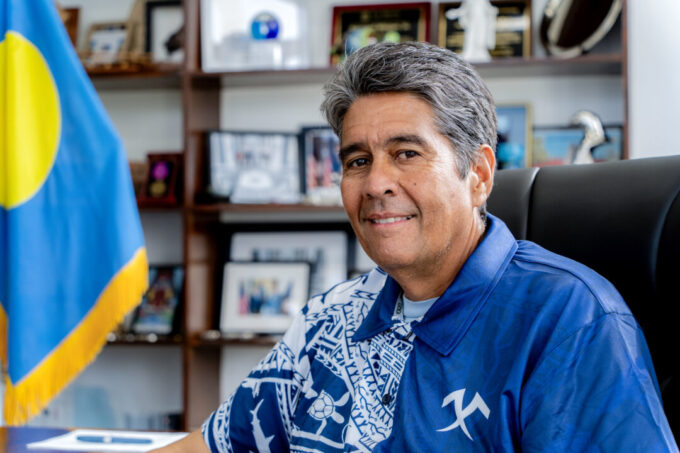
The Pacific Island President Standing Up to Beijing
KOROR, Palau—When Surangel Whipps Jr. was pursuing an MBA at UCLA in...
Wife of ‘God Bless the USA’ Singer Lee Greenwood Nominated as US Ambassador to Barbados
The wife of “God Bless the USA” singer Lee Greenwood was nominated...

AI Finance Is Here, but Scaling Hurdles Abound: Fintech Execs
A man uses a computer keyboard in Toronto in this Oct. 9,...