Taiwan Builds Whole-of-Society System to Keep Country Running in Crisis
 Arthur ZhangUpdated 2 days Ago5 Mins read
Taiwan is expanding preparations for a potential conflict with Beijing beyond the armed forces, moving deeper into the civilian systems that keep the island running—from food and fuel distribution to telecommunications, medical care, private businesses, and neighborhood emergency teams.
Taiwanese officials and foreign emergency management specialists described that shift at the Sept. 19 Resilient Taiwan for Sustainable Democracy International Forum in Taipei.
More than 500 domestic and international experts and guests attended the daylong event, which focused on gray-zone pressure tactics from China’s communist regime, geopolitical risks, civil-military coordination, and other resilience challenges.
President Lai Ching-te, who serves as convener of Taiwan’s Whole-of-Society Defense Resilience Committee, said the goal is to keep government and essential civilian functions operating through a crisis.
“Our goal is to ensure that the government can continue to operate effectively, and that society and essential services function as normal, should the nation face any type of disaster, be it natural or man-made,” Lai said. “And when necessary, our society must also be able to support military needs.”
Vice President Hsiao Bi-khim, who delivered closing remarks at the same forum, said Taiwan is building emergency stocks of food, fuel, and medicines while testing whether those supplies can actually reach people during disruptions.
“At the same time, we are testing how such supplies can be distributed,” Hsiao said.
Those efforts build on exercises Taiwan conducted earlier this year. In August, authorities deliberately throttled mobile communications across central and northern Taiwan for 30 minutes during urban-resilience drills held alongside the Han Kuang 42 military exercises.
The focus is increasingly on what happens below and between those large national drills—whether communities can function before outside help arrives, responders can communicate when commercial networks fail, companies know what supplies they may be asked to provide, and commercial supply chains can keep essential services operating.
From Earthquakes to Wartime Resilience
The forum followed a three-day earthquake exercise that tested many of the same civilian systems Taiwan would need during a conflict.
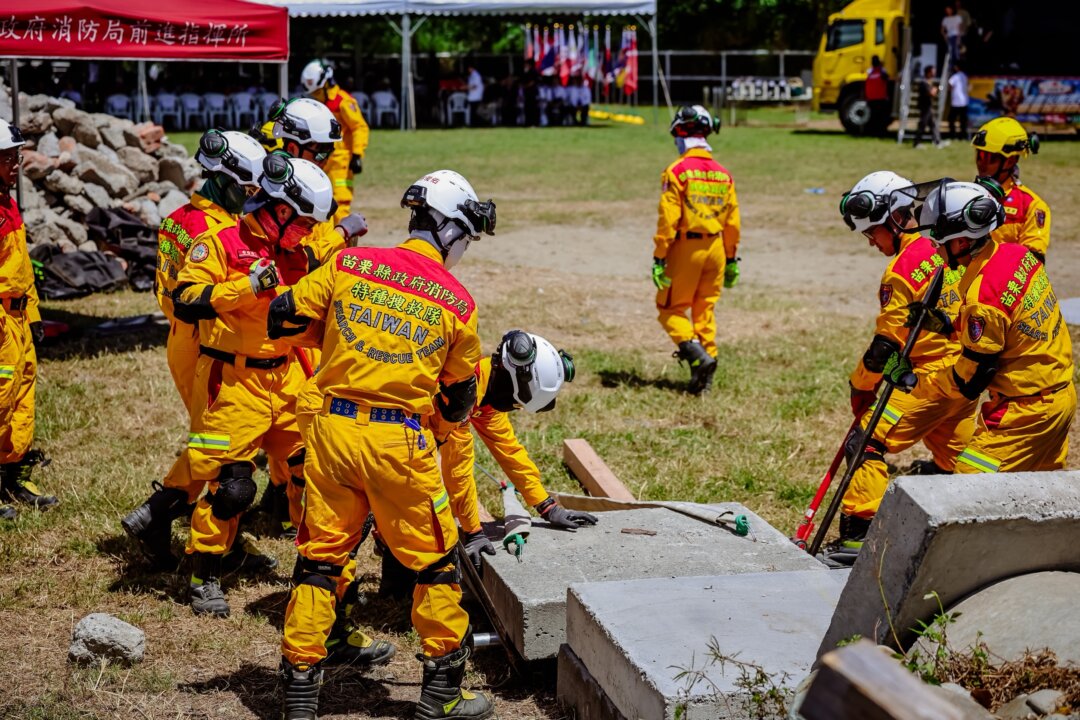
From Sept. 16 through Sept. 18, Taiwan simulated a magnitude 7.3 earthquake striking the eastern part of the island. The exercise involved 19 local governments, 17 central government agencies, the island’s three major telecommunications operators, businesses and civil groups, and experts and representatives from 36 countries, who observed or participated.

Taiwan officials and international participants in the 2026 Resilient Taiwan for Sustainable Democracy International Forum observe a large-scale earthquake response exercise in Taitung, Taiwan, on Sept. 17, 2026. The visit was part of Taiwan’s efforts to link disaster preparedness with whole-of-society resilience. Courtesy of Taiwan Ministry of the Interior
Authorities used what they called a “semi-warning, no-script” format, requiring participants to respond to changing conditions rather than follow a predetermined sequence.
Scenarios included damage to a power plant, loss of outside support, isolated communities, movement of emergency fuel and relief supplies by sea, and casualty evacuation.
Katie Sizemore, an international affairs fellow at the Council on Foreign Relations and former Federal Emergency Management Agency official, observed the exercise before speaking at the Sept. 19 forum.
She led seven FEMA delegations to Taiwan from 2022 to 2026 focused on crisis preparedness, disaster-response planning, and civil-military coordination.
It was the fourth time she had observed Taiwan’s annual earthquake exercise.
“It’s just so great to see the evolution and the seriousness with which Taiwan’s taking it,” Sizemore told the forum.
Taiwan is increasingly linking its disaster-response capabilities to defense planning.
Lai said this year’s Han Kuang military exercises and Urban Resilience Exercises were conducted together so civilian agencies and military units could train under the same crisis conditions.
“Safeguarding Taiwan has never been the responsibility of the military alone,” Lai said.
Keeping Supplies Moving
One practical problem is determining what food, fuel, industrial materials, and other supplies would actually be available during a prolonged disruption.
Deputy Economy Minister Ho Chin-tsang addressed the issue during a Sept. 19 forum panel on public-private cooperation. His portfolio includes industrial development and related technology programs.
Ho said the government is working with businesses to identify which strategic and civilian supplies can be produced domestically, which depend on imports, and how much needs to be held in reserve.
For basic goods, planners estimate demand using factors such as daily consumption and caloric requirements.
For industry, Ho said authorities need to know “which materials can be supplied locally” and which must be imported, along with the safety stocks available for those imports.
Much of that information is held by private companies, which Ho said may need to share inventory data so authorities can assess what would be available in an emergency.
“The government can sign MOUs with enterprises, or use open-ended contracts, to carry out emergency allocation or emergency requisition,” he said.
Ho cited Taiwan’s experience mobilizing mask production during the COVID-19 pandemic as an example of government and industry coordinating production and distribution during a national emergency.
Ho also discussed a more severe contingency—a maritime blockade that sharply restricted imported energy.
“When energy is extremely scarce, we may need to set priorities,” Ho said.
Defense needs and hospitals could receive priority, while production of some essential civilian goods and semiconductors might also need to continue, he said.
This planning sits within an established mobilization system.
The Ministry of Economic Affairs leads Taiwan’s Readiness Program for Mobilization of Material and Economic Resources, which includes nine subordinate plans covering areas such as oil and gas, food, coal, essential-goods rationing, important civilian and industrial supplies, electricity, water, and reservoir preparedness. The plans are issued annually under the Enforcement Rules for the All-out Defense Mobilization Readiness Act.
One of those plans requires authorities to maintain up-to-date information on manufacturers and production capacity, and to prepare the machinery, raw materials, water, electricity, and transportation needed to organize production during emergencies.
Taiwan’s mobilization exercises also test purchase orders, requisition orders, and production conversion orders for civilian transportation, supplies, factories, and repair capacity.
Backup Communications
Communications is another area where Taiwan has begun to test for failure rather than simply planning around it.
Hsiao said the August mobile data slowdown affected about 17 million people. Grassroots organizations responded by testing radios and mesh networks to maintain contact.
“The purpose was simple—to see what would happen if our normal communications, what we take for granted, were suddenly disrupted,” she said.
Sizemore said the remaining problem is not merely giving the public an alternative to cellular service. Emergency responders and government organizations must also be able to communicate with one another when their primary systems fail.
“One that is still … a struggle here that I’ve seen is the communication redundancy,” she said.
Responders need to be able to communicate with one another and “come together on a similar platform” with civilian and military units, Sizemore said.
The same principle applies at the community level because larger government systems may not arrive immediately.
“Having communities be able to sustain themselves until the larger government response occurs is really important,” Sizemore said.
Integrating Private Businesses
Another unresolved issue is how deeply to integrate the businesses that provide everyday goods and services.
Michael Kolton, a retired U.S. Army lieutenant colonel and professor at the Daniel K. Inouye Asia-Pacific Center for Security Studies in Hawaii, addressed that challenge during the Sept. 19 forum’s Military-Civilian Integration panel.
Kolton previously served at U.S. Indo-Pacific Command and held military and diplomatic assignments in Beijing and Taipei. His research includes China-Taiwan dynamics and whole-of-society resilience.
He said Taiwan has made substantial progress linking central and local governments, civil organizations, and emergency management systems, but cautioned against treating ever-larger national exercises as the next measure of progress.
“I don’t think it’s possible on the calendar to continue to add more” urban resilience exercises, Kolton said.
He said after-action reviews should drive smaller drills, workshops, and leadership exercises between major national events.
“The most important thing for me on this topic is use that to really identify: What didn’t we get done? What can’t we get done?” Kolton said.
The more difficult next step, he said, is integrating small and medium-sized private companies.
Kolton pointed to businesses that handle food delivery, propane, vehicle repairs, and other services people depend on every day. Unlike government utilities, their inventory, logistics, and operating information generally remain in private systems.
He used convenience stores as an example, saying they are within minutes of many homes and could become important during a crisis, while their logistics and inventory information remain privately held.
Those businesses’ “data, their insights, their needs are in their proprietary systems,” Kolton said.
Those arrangements—what information companies share, what the government expects of them, and how they would operate during a disruption—have to be worked out before a crisis.
“It’s time to bring in the private sector,” Kolton said.


U.S. and China extend trade truce by two months as Xi met by Trump for start of visit
Chinese President Xi Jinping and U.S. President Donald Trump at Joint Base...

Alberta activist convicted of promoting hatred at Toronto’s Pride Parade
William Whatcott outside the Supreme Court of Canada in Ottawa on Oct....
Trump Greets Xi in Person at Joint Base Andrews; Senators Urge Rubio to Release $15B Aid to Taiwan
President Donald Trump greets Chinese leader Xi Jinping in person as the...
House China Committee Chairman Lays Out Expectations for Trump-Xi Summit
WASHINGTON—President Donald Trump’s meetings with Chinese President Xi Jinping this week come...