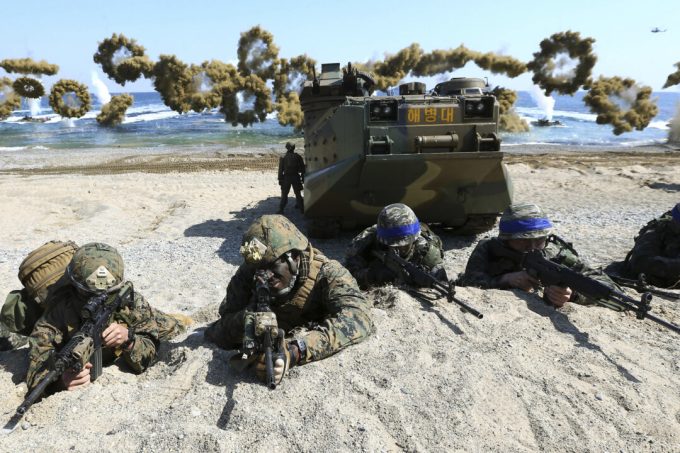

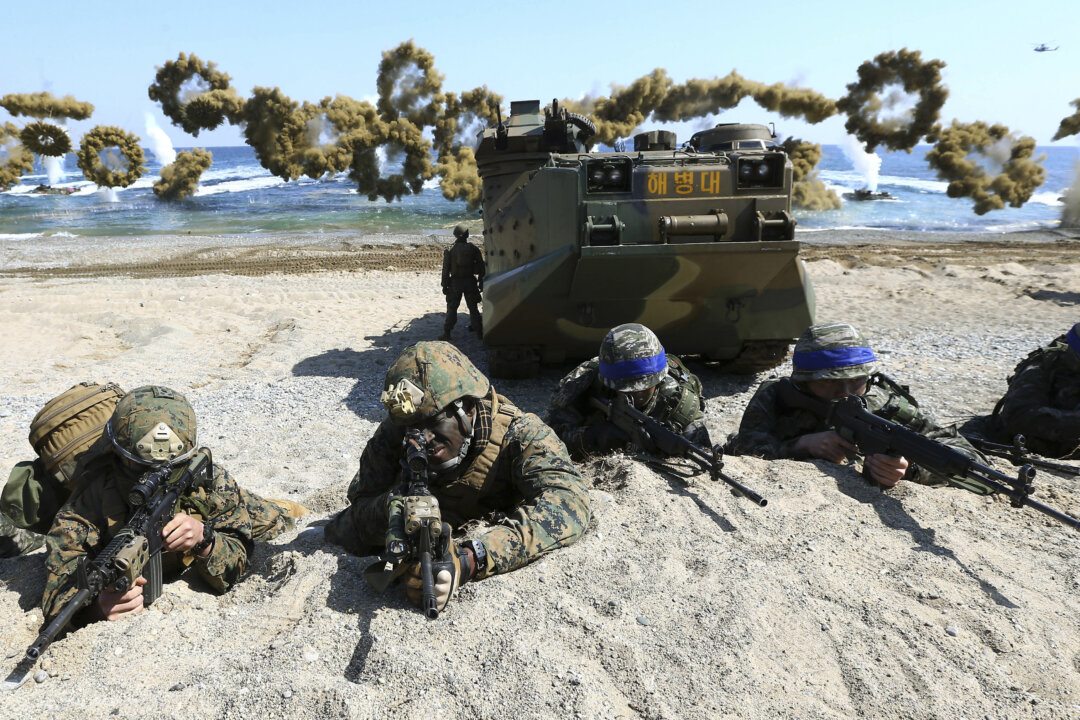
The United States axed a military exercise with South Korea scheduled for September, the East Asian nation’s Marine Corps said on Monday.
Washington’s cancellation of the joint amphibious landing manoeuvres comes after it cited limitations on its forces brought on by the ongoing war with Iran.
“The U.S. Marine Corps formally notified our forces in June that its ability to deploy forces during this year’s Ssangyong exercise would be constrained due to the situation in the Middle East,” Han Seung-jeon, a spokesman for the South Korean Marine Corps, said at a news briefing, Channel News Asia reported.
Seoul and Washington were continuing consultations on resuming the amphibious exercise, he said, without giving details.
“Ssangyong” means “two dragons” representing South Korea and the United States, and is intended to strengthen combat readiness and combined interoperability between the two nations’ militaries, according to a description of the exercise issued by the U.S. Navy’s Pacific Fleet.
In addition, it is intended to advance the South Korean Marine Corps’ Marine Task Force and command-and-control capabilities through combined training and amphibious operations.
Ssangyong has been carried out regularly since its inception in 2012 and was last conducted in 2024.
The Epoch Times contacted the Pentagon, the U.S. Pacific Fleet, the U.S. Marine Corps, and U.S. Forces Korea for comment but did not receive a response by the time of publication.
The cancellation follows President Donald Trump’s Aug. 16 order to pare back another joint military exercise that ended on Aug. 21, citing the cost of the drill as well as Seoul’s refusal to support Washington in its war with Iran.
In a Truth Social post, Trump said his relationship with North Korean leader Kim Jong Un made him question the need for large-scale military exercises.
He said the exercises were not only costly—much of the cost is borne by the United States—but also sent what he described as a signal that was “totally inappropriate and hostile” toward North Korea, which he said had been “unthreatening and respectful” during his presidency.
The president also said that he planned to meet with Kim later this year, building on previous
in 2018 and 2019 during Trump’s first term.
Trump also linked the issue to broader disagreements with Seoul, saying South Korean President Lee Jae-myung had declined a U.S. request to support efforts related to the Iran conflict.
South Korean Foreign Minister Cho Hyun said on Aug. 19 that Trump’s decision appeared to serve several political purposes beyond military planning.
“I think President Trump’s message includes pressure over several pending issues concerning the South Korean government, as well as a message to North Korea and an intention by the United States to break a stalemate in the Iran war,” Cho said.
He also said that Seoul had not finalized investment details of the planned $350 billion
in the United States because officials needed to assess commercial viability and complete legal procedures.
Pyongyang, via Kim Yo-jong, Kim’s sister, appeared to dismiss Trump’s gesture of reducing joint military exercises with South Korea.
She said on Wednesday that the “provocative” and “aggressive nature” of the joint military drills would not change despite the reduction in the size and duration of the exercise.
“If the U.S. calculates that it can propagate its recent measure as one of so-called good faith, they will not get the desired answer,” she said.
She also said that she was unaware of recent communication between the two leaders.
After Seoul’s comments on the reduction of the drills, North Korea launched about 10 short-range ballistic missiles toward the Sea of Japan on Aug. 20.
South Korea’s joint chiefs of staff said the ballistic missiles were launched from North Korea’s capital region around 5 p.m. local time on Aug. 20.
The missiles each flew about 186 miles toward North Korea’s eastern waters, according to South Korean officials.
Evgenia Filaminova, Timothy Frudd, and Jacki Thrapp contributed to this report.