US Envoy Warns Taiwan Conflict Would Inflict Greater Economic Toll Than World War II
 Frank FangUpdated 4 hours Ago2 Mins read
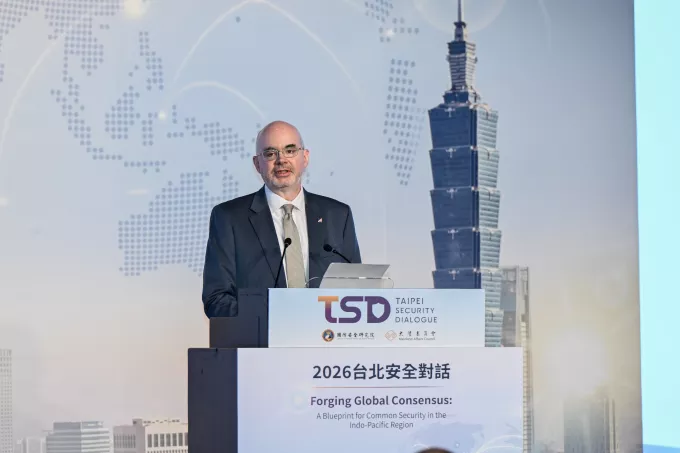
TAIPEI, Taiwan—A conflict across the Taiwan Strait would deliver a devastating shock to the global economy, says the top U.S. diplomat in Taipei.
Raymond Greene, director of the American Institute in Taiwan (AIT), the de facto U.S. Embassy in Taiwan, made the remarks at a defense forum in Taipei on Wednesday, saying there’s “no topic more timely or important” than securing peace in the strait.
China’s communist regime considers democratically governed Taiwan to be a Chinese province, even though it has never ruled the island. Beijing has demanded that countries adhere to its “one-China principle,” under which the regime claims sovereignty over Taiwan and has not renounced the use of force to bring it under its control.
“Beyond the human toll, any conflict across the Taiwan Strait would cost the global economy more than during the Second World War,” Greene said.
The Taiwan Strait is a vital waterway for international trade. The Center for Strategic and International Studies
found
that more than a fifth of global maritime trade passed through the strait in 2022, worth about $2.45 trillion, and said that a conflict there would “send shockwaves beyond Taiwan and China.”
Greene said the Trump administration has made “preserving peace” in the Indo-Pacific region one of its top priorities. Those efforts include “vigorous diplomacy,” particularly at the highest levels, he added.
His remarks come weeks before U.S. President Donald Trump is scheduled to meet with Chinese leader Xi Jinping in Washington.
“The upcoming U.S.–China summit is an opportunity to further advance a relationship of strategic stability, on the basis of fairness and reciprocity, that can avoid misunderstandings and miscalculations,” Greene said.
Trump has
said
that he will host a formal state dinner for Xi on Sept. 24.
Taiwan is likely to be among the issues on the agenda. At their previous summit in Beijing in May, Trump and Xi discussed Taiwan, but Washington’s longstanding policies toward the island
remained
unchanged afterward. Trump told reporters he declined to clarify his position on Taiwan when Xi asked whether the United States would defend the island.
Washington has long maintained a “one-China policy,” acknowledging that there is only one “China” without recognizing Beijing’s sovereignty over Taiwan.
The United States and Taiwan do not have formal diplomatic relations, but Washington is Taiwan’s largest arms supplier, providing weapons for the island’s self-defense under the Taiwan Relations Act.
Greene noted that the United States is bolstering its regional presence along the first island chain while directly supporting Taiwan’s self-defense capabilities.
The first island chain runs southward from Japan through Taiwan and the Philippines to Malaysia. It is considered a barrier that prevents China from easily accessing the Pacific Ocean with its naval and air forces.

Taiwanese Vice President Hsiao Bi-khim speaks at the 2026 Taipei Security Dialogue in Taipei, Taiwan, on Sept. 9, 2026. Sung Bi-lung/The Epoch Times
Taiwanese Vice President Hsiao Bi-khim also spoke at the event—officially called the 2026 Taipei Security Dialogue—emphasizing the island’s responsibility to strengthen its defenses.
“Our purpose, of course, is to preserve peace and the freedom of Taiwan’s people to determine their future,” Hsiao said. “Better preparation gives us a basis for pursuing that purpose with steadiness and strength.”
In August, Taipei proposed a record-high defense budget of 1.12 trillion Taiwan dollars, or roughly $35 billion, for 2027.
Hsiao also reiterated Taiwan’s opposition to any attempt by China to unilaterally change the status quo across the Taiwan Strait.
“We are working with international partners to make that position effective in practice,” she added.
Aside from direct military threats, China has also used gray-zone tactics in an effort to pressure Taiwan into submission. These include sending military aircraft and vessels into areas surrounding the island, as well as conducting large-scale military drills in the region.
Tung Chee-hwa, Hong Kong’s First Leader Under Chinese Communist Rule, Dies at 89
Tung Chee-hwa, Hong Kong’s first chief executive after Britain turned over the...
Thieves Steal 2 Renoir Paintings From French Riviera Museum, Drop 2 More
Police officers patrol in front of the entrance of the Musée Renoir...
Kyiv to Buy 1,000 Missiles for Patriot Air Defense Systems From Allies
Kyiv is contracting the supply of 1,000 missiles for its U.S.-made Patriot...
Police Investigate Nigel Farage’s Reform UK Over Donations
Britain's Reform UK leader Nigel Farage arrives at Southwark Crown Court in...