US Treasury Bond Yields Keep Climbing: What to Know
 Andrew MoranUpdated 3 hours Ago4 Mins read
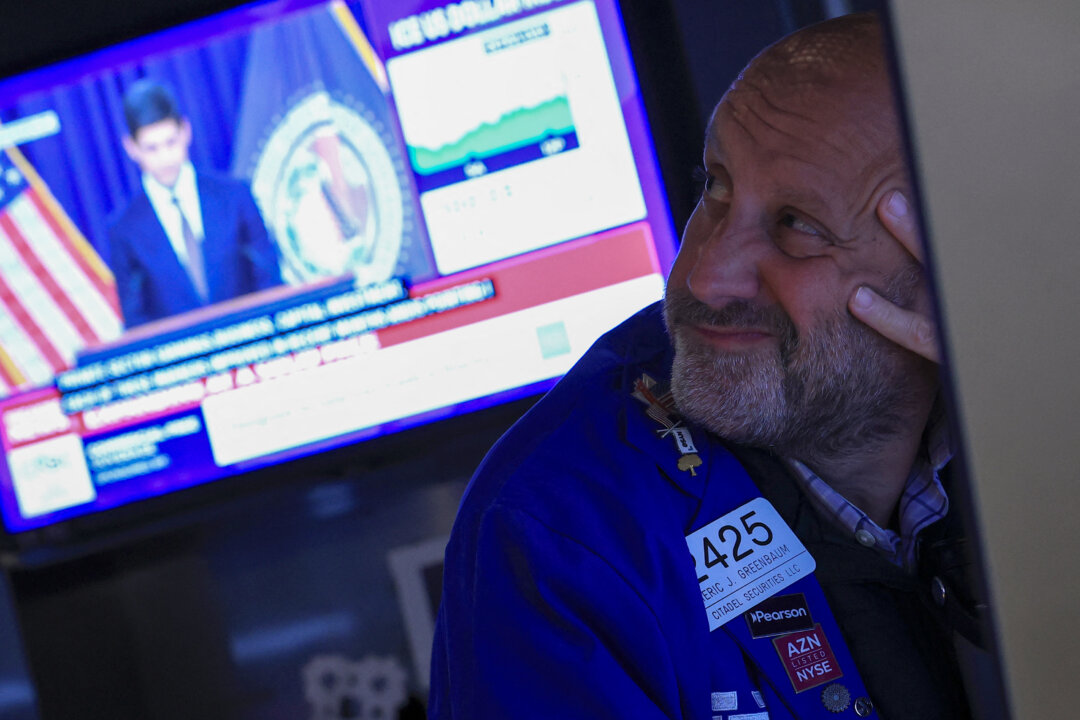
The global bond market rout continued this week as yields rose across advanced economies, with U.S. Treasury securities in the spotlight.
The benchmark 10-year Treasury yield on Sept. 25 touched 5.2 percent, its highest level since June 2007. The 30-year Treasury bond yield was hovering around 5.5 percent for the first time in more than two decades.
While the yield curve has steadily risen since late February, turmoil in the U.S. government bond market has intensified over the last several weeks.
A range of factors, from war-driven inflation to fiscal fears, is driving volatility.
Here is what to know as U.S. Treasury bond yields keep climbing.
Strong Economic Data
This week was light on major economic data compared to other weeks, but several notable data points were published.
First, S&P Global reported that business conditions strengthened to their best level since early 2015, excluding the COVID-19 pandemic years of 2020 and 2021. Both the manufacturing and services sectors logged their fastest pace of growth in about four years.
Employment conditions remained solid as unemployment claims stayed below 200,000 for the second consecutive week, according to the Department of Labor. Initial jobless claims have been in a historically low range of 189,000 to 230,000 all year.
New home sales surged more than 6 percent in August, up from the previous month’s 4.3 percent decline.
Last month, new orders for US-manufactured durable goods were unchanged, but they came in better than the consensus estimate of a 0.4 percent decline.
“Activity measures in the US, like New Order PMIs, make it clear we are in an extremely ebullient growth phase,” Giuseppe Sette, co-founder and president at AI investment analytics firm Reflexivity, said in an emailed note to The Epoch Times.
“If real growth is strong, one has to expect nominal bond rates to adjust. Keep calm and carry on, this is just how bonds are supposed to work.”
The U.S. economy is projected to expand 5 percent in the third quarter, according to the Atlanta Federal Reserve’s widely watched GDPNow Model.
Given a resilient economic climate, the Fed could also have additional room to raise interest rates at least once more before the year is over.
Hunt for a Hike in October
The Federal Reserve could raise interest rates again next month.
Traders are betting on a back-to-back quarter-point rate hike at the October Federal Open Market Committee policy meeting. The odds of another boost to the benchmark federal funds rate stand at 69 percent, according to CME FedWatch data.
In addition to solid economic data, futures markets took their cues from a phalanx of comments by Fed officials in recent days.
Most notably, Fed Governor Michael Barr said a rate increase was likely due to persistent above-trend inflation.

Federal Reserve Board Governor Michael Barr participates in a board meeting at the Federal Reserve in Washington on March 19, 2026. Kevin Dietsch/Getty Images
Barr, who was previously the Fed’s vice chair for supervision, defended the September policy move, saying he and his colleagues “were out of position, and we made an adjustment in the right direction.”
“In my base case, further policy adjustments are likely to be needed to ensure inflation comes down to target in a timely fashion,” Barr said in a Sept. 23 speech at an event hosted by the Chicago Fed. “We want to support sustainable, durable growth in support of maximum employment, and price stability is crucial to that.”
Cleveland Fed President Beth Hammack echoed these remarks.
Hammack said in her opening remarks at a Sept. 24 conference that current economic conditions are solid and the labor market is “closer to my definition of maximum employment.”
“But inflation remains elevated,” she said. “The inflation outlook continues to be highly uncertain, with risks tilted to the upside. … The longer that high inflation persists, the more challenging and costly it can be to bring it back down.”

A marble American eagle sculpture sits atop the Marriner S. Eccles Federal Reserve Board Building in Washington on Aug. 13, 2026. Alex Wong/Getty Images
Another look at inflation will happen next week. The Fed’s go-to inflation measure—the August Personal Consumption Expenditures (PCE) Price Index—will be published on Sept. 30.
Some economists forecast the annual PCE inflation rate will tick up to 3.8 percent, from 3.7 percent in July. Excluding the volatile energy and food prices, the 12-month core PCE inflation rate is also forecast to edge up to 3.4 percent, from 3.3 percent in the previous month.
The Fed will hold its next two-day policy meeting on Oct. 27 and 28.
Treasury Buybacks
Before a Sept. 24 buyback operation, the Treasury Department said it would purchase up to $6 billion of 20- and 30-year government debt.
But the department confirmed that it bought back only $4.078 billion in long-dated bonds after offering more than $10 billion.
The Treasury has conducted more than 150 operations totaling approximately $500 billion. Officials are repurchasing long-dated government debt to lower long-run yields, then issuing short-term securities.

The U.S. Treasury building in Washington on June 28, 2026. Al Drago/Getty Images
It plans to conduct more debt buyback operations this year, with each event aiming to repurchase between $750 million and $4 billion in short- and long-dated bonds.
The Treasury held a $70 billion five-year auction on Sept. 23, and mixed demand yielded 5.03 percent for the first time since 2006.
‘This Is Not a Crisis’
Despite the spike in U.S. Treasury yields, the stock market continues to push ahead, with some leading benchmark averages flirting with record highs.
The tech-heavy Nasdaq Composite Index reached a record high this week, while the broad-market S&P 500 is about 100 points shy of an all-time high.
The blue-chip Dow Jones Industrial Average is seeking to reclaim 52,000.
Market watchers have debated in recent weeks whether elevated yields weigh on equities.
“When the 10-year Treasury yield reaches levels not seen since 2007, it changes the math for equities,” David Miller, senior portfolio manager at Catalyst Funds, said in a note emailed to The Epoch Times.
Higher long‑term rates make future profits worth less in today’s dollars and offer investors a far more attractive risk‑free option, Miller noted.
This typically squeezes highly valued growth stocks and shifts attention toward firms that generate solid cash now, have pricing power, and carry sturdy balance sheets.
Laffer Tengler Investments CEO Nancy Tengler said stock price performance and bond yields are not correlated.
“In the ‘90s, we had higher interest rates coexist with robust stock price returns. The 10-year averaged between 5% and 8% in the ’90s. Inflation was 3%,” Tengler told The Epoch Times in an emailed note. “You can make money below 3%, and you can make money in stocks above 6%.”

A trader wipes his brow while working on the floor of the New York Stock Exchange on Aug. 10, 2007. Mario Tama/Getty Images
Another argument that other market watchers make is that this could be a normalization of interest rates after about 20 years of ultra-low rates following the global financial crisis.
From 2007 to 2022, the 10-year yield fell from around 5 percent to as low as 0.65 percent. Likewise, the 30-year yield declined from 5.12 percent to below 1.4 percent.
“Old veterans like myself would say we are normalizing interest rates. This is not a crisis,” Tengler said.






US Consumer Sentiment Remains Near Historically Weak Lows: UMich
U.S. consumer sentiment remained near a historically weak level this month amid...

How to Invest in Palladium
You’ve probably seen a few ads on TV or on the internet...

What to Know About Trump’s National Security Deal With Greenland, Denmark
President Donald Trump and the leaders of Greenland and Denmark signed a...

Actress Susan Sarandon Among 30 Arrested Protesting Against Netanyahu in New York
Actresses Sarah Sarandon and Hannah Einbinder and two Democratic politicians were among...