Younger Canadians most divided on academic freedom protecting political views: poll
 Kenn OliverUpdated 4 hours Ago3 Mins read


Article content
Political advocacy in a post-secondary classroom where it does not relate to the subject matter could become a “threat to academic freedom” if left unchecked, warns Association for Canadian Studies president Jack Jedwab.

THIS CONTENT IS RESERVED FOR SUBSCRIBERS
Enjoy the latest local, national and international news.
- Exclusive articles by Conrad Black, Barbara Kay and others. Plus, special edition NP Platformed and First Reading newsletters and virtual events.
- Unlimited online access to National Post.
- National Post ePaper, an electronic replica of the print edition to view on any device, share and comment on.
- Daily puzzles including the New York Times Crossword.
- Support local journalism.
SUBSCRIBE FOR MORE ARTICLES
Enjoy the latest local, national and international news.
- Exclusive articles by Conrad Black, Barbara Kay and others. Plus, special edition NP Platformed and First Reading newsletters and virtual events.
- Unlimited online access to National Post.
- National Post ePaper, an electronic replica of the print edition to view on any device, share and comment on.
- Daily puzzles including the New York Times Crossword.
- Support local journalism.
REGISTER / SIGN IN TO UNLOCK MORE ARTICLES
Create an account or sign in to continue with your reading experience.
- Access articles from across Canada with one account.
- Share your thoughts and join the conversation in the comments.
- Enjoy additional articles per month.
- Get email updates from your favourite authors.
THIS ARTICLE IS FREE TO READ REGISTER TO UNLOCK.
Create an account or sign in to continue with your reading experience.
- Access articles from across Canada with one account
- Share your thoughts and join the conversation in the comments
- Enjoy additional articles per month
- Get email updates from your favourite authors
Sign In or Create an Account
or
Article content
While new polling for the organization indicates the majority (60 per cent) of Canadians firmly feel academic freedom shouldn’t protect a professor who uses class time to push personal political views unrelated to the curriculum, the 18-24-year-old cohort was the most conflicted, with only 38 per cent sharing that opinion, 32 per cent in support of protection and 30 per cent unsure.
Article content
Article content
Article content
Generation Xers between 55-64 (70 per cent) and boomers 65 and over (73 per cent ) were most likely to disagree.
Article content
By signing up you consent to receive the above newsletter from Postmedia Network Inc.
Article content
Jedwab isn’t surprised most respondents feel “there’s a line” for academic freedom protection and reasoned the youngest cohort, predominantly students, are divided due to their exposure.
Article content
“It’s hard to contend when your professor advocates a particular cause,” he told National Post in an interview. “It can be very challenging to reflect on whether this is crossing a line or not.”
Article content

Article content
He highlighted the recent Campus Anti-Semitism Student Experiences report commissioned by Heritage Canada, which he co-authored, which found that 34 per cent said a professor brought up Jews, Judaism, Israel, or Zionism when unrelated to the course subject.
Article content
“In a course that had nothing to do with Israel, my professor spent three weeks talking about Gaza and the creation of the State of Israel,” one Jewish student told researchers. “He never mentioned the Holocaust as a precursor to its founding, repeatedly calling the state a ‘Zionist political project.’”
Article content
Jedwab, a Ph.D. himself, stopped here to stress the critical importance of academic freedom, but said it’s also critical to have a frank conversation about the checks and balances “when it comes to the roles and responsibilities of academics around controversial issues that are not within the purview of what they’re being asked to teach.”
Article content
Article content
“The risk is that academic freedom is being abused by some parties in pursuit of a particular cause,” he added.
Article content
Article content
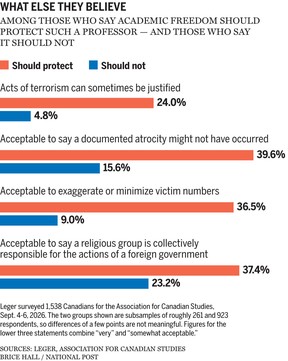
Polling also identified that among those who support academic freedom protection in those instances, “are also considerably more likely to regard the justification of terrorism, the denial of documented atrocities and the minimization of their victims as acceptable.”
Article content
Almost four in 10 (39.6 per cent) think it’s very or somewhat acceptable to say that a well-documented historical atrocity might not have occurred. More than a third (36.5 per cent) felt it was acceptable, to some degree, to exaggerate or minimize the number of victims of historical atrocities and more still (37.4 per cent) think it’s to some degree acceptable to say that members of a religious group are collectively responsible for the actions of a foreign government.
Article content
Article content
Jedwab said that adds to the need “to reflect on the extent to which these types of freedoms are indeed detrimental to the well-being of individual Canadians.”
Article content
Perhaps more alarming, nearly one in four (24 per cent) believe acts of terrorism can sometimes be justified. (67.3 per cent said it cannot and 8.7 per cent were unsure.)






Head of Church of England rescinds interfaith award given to Muslim cleric who praised bin Laden
Sarah Mullally during a ceremony installing her as the 106th Archbishop of...

Frank Stronach won’t have to go to jail, judge says, after dramatic day of argument
Frank Stronach leaves a Toronto courthouse after sentencing arguments of a conviction...

Chinese Entrepreneur Activist Escapes China, Meets Many Fellow Travelers on the Way to Freedom
Chinese entrepreneur and rights activist Shen Qijia recently escaped China after reporting...

As Ottawa Woos Business With New Reforms, Observers Question the State’s Continued Hand in the Economy
News AnalysisAnnouncements by the federal government at the recent Canada Investment Summit...