Randall Denley: Cheerleading for Mark Carney isn’t a sound economic plan, Premier Ford
 Randall DenleyUpdated 5 hours Ago3 Mins read
Article content
Everything that’s wrong with Ontario’s approach to economic development was on full display Wednesday.

THIS CONTENT IS RESERVED FOR SUBSCRIBERS
Enjoy the latest local, national and international news.
- Exclusive articles by Conrad Black, Barbara Kay and others. Plus, special edition NP Platformed and First Reading newsletters and virtual events.
- Unlimited online access to National Post.
- National Post ePaper, an electronic replica of the print edition to view on any device, share and comment on.
- Daily puzzles including the New York Times Crossword.
- Support local journalism.
SUBSCRIBE FOR MORE ARTICLES
Enjoy the latest local, national and international news.
- Exclusive articles by Conrad Black, Barbara Kay and others. Plus, special edition NP Platformed and First Reading newsletters and virtual events.
- Unlimited online access to National Post.
- National Post ePaper, an electronic replica of the print edition to view on any device, share and comment on.
- Daily puzzles including the New York Times Crossword.
- Support local journalism.
REGISTER / SIGN IN TO UNLOCK MORE ARTICLES
Create an account or sign in to continue with your reading experience.
- Access articles from across Canada with one account.
- Share your thoughts and join the conversation in the comments.
- Enjoy additional articles per month.
- Get email updates from your favourite authors.
THIS ARTICLE IS FREE TO READ REGISTER TO UNLOCK.
Create an account or sign in to continue with your reading experience.
- Access articles from across Canada with one account
- Share your thoughts and join the conversation in the comments
- Enjoy additional articles per month
- Get email updates from your favourite authors
Sign In or Create an Account
or
Article content
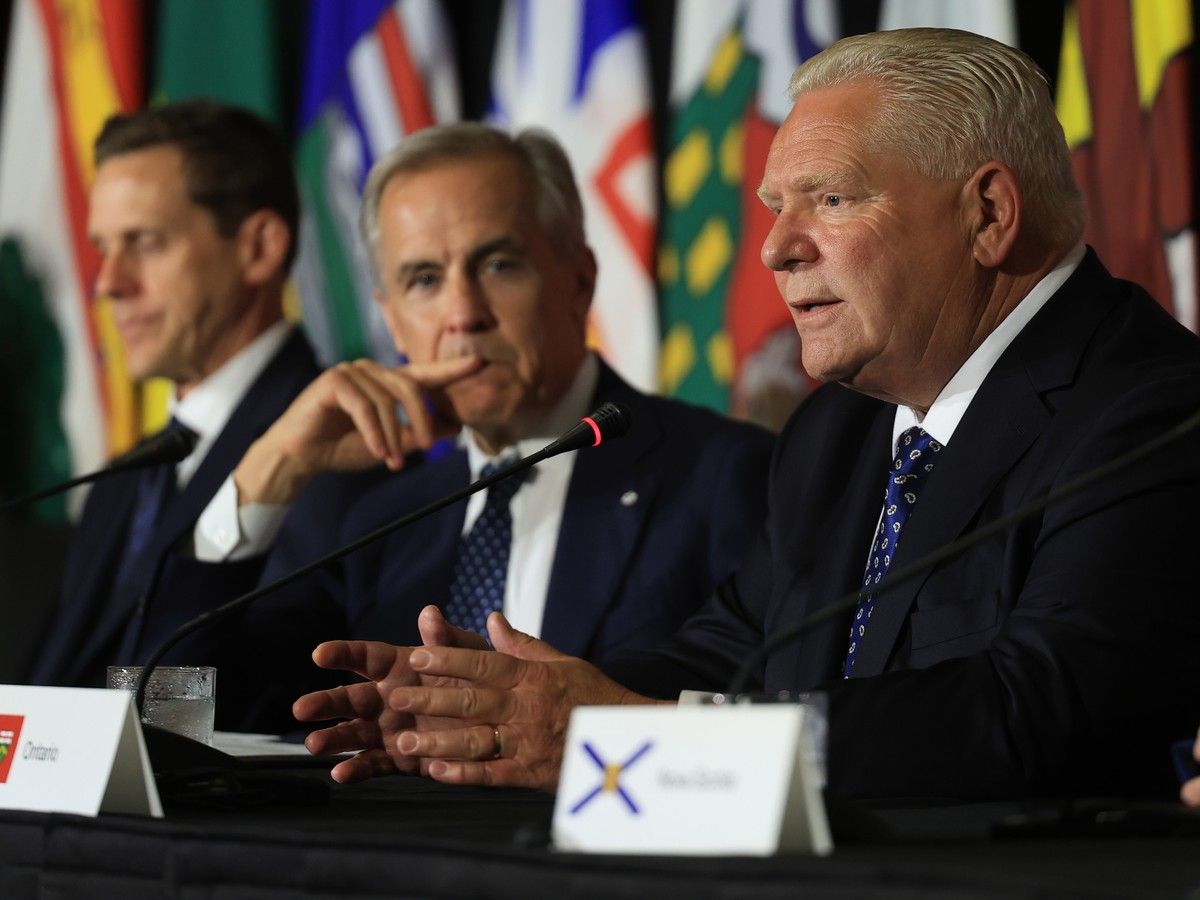
In just one public event, Premier Doug Ford demonstrated his belief that companies need a government handout to build in Ontario, endorsed the backward-looking approach that favours old, failing industries over new ones, and continued his vigorous cheerleading for Mark Carney, whether the prime minister’s economic plans are good for Ontario or not.
Article content
Recommended Videos
Article content
Article content
The occasion was the opening of a Toronto vaccine-manufacturing plant owned by the French pharmaceutical company Sanofi. Joining Ford on stage were Federal Industry Minister Mélanie Joly and sundry other politicians.
Article content
By signing up you consent to receive the above newsletter from Postmedia Network Inc.
Article content
After explaining how Ontario’s educated workforce, abundant power, good government, etc. made the province a compelling place to invest, Ford offered the Sanofi plant as proof.
Article content
OK, but if Ontario is such a great investment opportunity, why did it take $415 million in federal money and $55 million from the province to get Sanofi to build it? That’s more than half of the plant’s $925 million cost. For all that expense, Ontario gets 300 jobs. That’s a subsidy of nearly $1.6 million a job.
Article content
How could that possibly make sense? Last year, Sanofi made a net income equivalent to $15.3 billion Canadian, but in Ontario, the company is a charity case.
Article content
“If you are going to invest in Ontario, we are going to invest in you,” Ford said.
Article content
At least the Sanofi jobs are new. Ford’s main preoccupation is fighting for past jobs, even ones that are already gone. This year’s provincial budget sets aside $30 billion for job protection and reducing the impact of U.S. tariffs.
Article content
Article content
Asked about the future of a closed Stellantis auto plant in Brampton, Ford had the chance to show a bit of economic common sense. Stellantis has signed a memorandum of understanding to sell the plant to an armoured vehicle manufacturer called Roshel. The Brampton-based company is competing for a $4.9-billion federal contract.
Article content
That could be a perfect solution for the Stellantis problem. Roshel is a Canadian-owned company that makes a product for which there is a demand. It wants to buy the plant and hire workers. Isn’t that better than griping over losing an American car company that doesn’t want to be here?
Article content

Article content
Instead of pushing that deal, Ford and Joly persisted in their demand that Stellantis bring back production to the plant, which has been closed for three years. Joly was more eager to recoup the $222 million the feds poured into the plan than she was to talk about a future for the building.
Article content
Both politicians are taking their cues from Unifor, the union that represents the auto workers. That’s not the first group one should turn to when considering the big picture.
Article content
Then, Ford was asked about Carney’s plan to privatize the operation of Pearson International Airport, which Ford called “fabulous.” He said that airports should have been privatized years ago and that “times have changed. It’s not about government funding everything.”






Head of Church of England rescinds interfaith award given to Muslim cleric who praised bin Laden
Sarah Mullally during a ceremony installing her as the 106th Archbishop of...

Frank Stronach won’t have to go to jail, judge says, after dramatic day of argument
Frank Stronach leaves a Toronto courthouse after sentencing arguments of a conviction...

Chinese Entrepreneur Activist Escapes China, Meets Many Fellow Travelers on the Way to Freedom
Chinese entrepreneur and rights activist Shen Qijia recently escaped China after reporting...

As Ottawa Woos Business With New Reforms, Observers Question the State’s Continued Hand in the Economy
News AnalysisAnnouncements by the federal government at the recent Canada Investment Summit...