Washington, Tokyo Strengthen Economic Defenses Against Beijing
 Jarvis LimUpdated 5 hours Ago3 Mins read
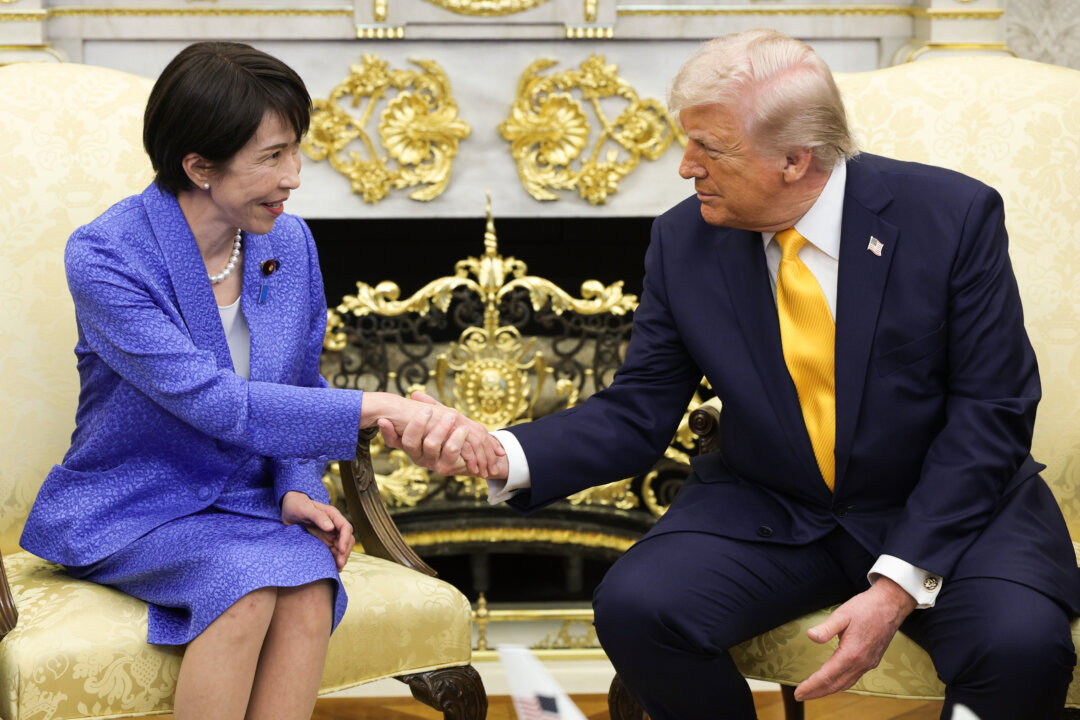
The United States and Japan on Sept. 22 moved to align their strategies to address economic challenges and Indo-Pacific security in relation to China.
President Donald Trump sat down with Japanese Prime Minister Sanae Takaichi for approximately 35 minutes in New York on Tuesday, two days before the Trump–Xi summit on Sept. 24.
According to a summary published by the Japanese Prime Minister’s Office, the two leaders “exchanged views on issues related to China, including economic security, and concurred that Japan and the United States will coordinate closely.”
They agreed to expand cooperation in fields such as artificial intelligence (AI), semiconductors, and critical minerals to stay ahead in the technology race.
Both sides reaffirmed their commitment to the Quad alliance—which includes the United States, Australia, Japan, and India—and a free and open Indo-Pacific.
The talks took place two days before Trump
met with
Chinese leader Xi Jinping at the White House on Sept. 24.
The timing of the meeting itself is “the most important message,” said Bonnie Yushih Liao, a senior research fellow at the Japan Forum for Strategic Studies in Tokyo.
“This is not simply another routine U.S.–Japan summit. It gives Tokyo an opportunity to make sure Washington hears the concerns of its closest Asian ally before the United States enters a major negotiation with Beijing,” Liao told The Epoch Times.
Japan–China relations have soured since Takaichi
said
in November 2025 that her country would be justified in activating its Self-Defense Forces if Taiwan were attacked.
Chinese authorities followed her remarks with a series of
military provocations
and economic coercion measures.
Wang Hung-jen, chairman of the Taiwan Society of Japan Studies, said the U.S.–Japan summit reflects Tokyo’s push to ensure its security interests are embedded in Trump’s strategic framework.
“It sends a message to Beijing that even if Trump and Xi establish personal diplomatic ties, the U.S.-Japan alliance will not be sidelined,” Wang told The Epoch Times.
“Reaffirming the alliance’s deterrence, economic security, and Indo-Pacific commitments directly addresses the strategic challenges posed by China.”
Taiwan Factor
Tokyo’s readout of the talks made no mention of Taiwan.
However, on the sidelines of the U.N. General Assembly in New York on Sept. 21, U.S. Secretary of State Marco Rubio, Japanese Foreign Minister Motegi Toshimitsu, and South Korean Foreign Minister Cho Hyun
stressed
their backing for Taipei.
The self‑governed island is a democracy that the Chinese Communist Party (CCP) has never controlled but has repeatedly
threatened
to annex by force.

Chinese ships patrol as the People’s Liberation Army (PLA) conducts military drills on Pingtan Island—the closest point to Taiwan—in eastern Fujian Province, China, on Dec. 30, 2025. Adek Berry/AFP via Getty Images
Liao said it would be surprising if Taiwan were completely absent from the U.S.–Japan talks, even if the published account contained no detailed language on the matter.
“For Japan, Taiwan is increasingly connected to Japan’s own security environment,” Liao said.
“A serious contingency in the Taiwan Strait would affect Japan’s southwestern islands, U.S. forces based in Japan, major maritime routes, and ultimately the defense of the first island chain.”
The first island chain—which includes Taiwan, mainland Japan, and the Philippines—is widely seen by analysts as a strategic buffer limiting China’s ability to
project
military power into the Pacific.
Tokyo can hardly regard Taiwan “simply as a bilateral issue between Washington and Beijing” anymore, according to Liao.
Liao said the deeper question is whether Washington and Tokyo increasingly see Taiwan, the East China Sea, and Japan’s southwestern islands as a single connected area that Beijing must be deterred from encroaching on.
“If that is happening, it is strategically much more important than the wording of any single communiqué,” she said.
“For Tokyo, Taiwan is no longer just a Taiwan issue. It is becoming part of Japan’s own security geography.”
Countering China
Wang pointed to mineral and AI cooperation as the clearest sign that Washington and Tokyo now read the Chinese threat the same way.
“Beijing has turned rare earths from an economic tool into a strategic weapon,” Wang said.
“Now, the United States and Japan are trying to elevate efforts to reduce dependence on China from industrial policy to alliance strategy.”
Washington has
accused
some Chinese firms of tapping U.S. AI models through methods such as “distillation.”
Beijing sharply
cut
rare earth exports to Japan after Takaichi’s remarks on Taiwan, disrupting supply chains relied upon by both Japanese and U.S. manufacturers.

A view of the under-construction Rare Earth Industrial Park in Anyuan county, Ganzhou, in eastern China’s Jiangxi province on Nov. 21, 2025. Hector Retamal/AFP
While China accounts for roughly 70 percent of global rare earth mining production, it controls close to 90 percent of the world’s refining and processing capacity.
Liao said building alternative mineral supply chains takes years, so joint efforts by Washington, Tokyo, and like-minded nations would work best if they were based on diversification, redundancy, and a collective response.
“Imagine a different situation: a restriction against one country triggers coordinated action among the United States, Japan and other partners,” she said.
“Then Beijing has to make a very different calculation before using economic pressure.”
Liao said rare earth curbs that drive Tokyo, Washington, and others to develop new sources together may ultimately cost the regime more than any short-term political leverage.
“The next stage of the U.S.–Japan alliance will increasingly include economic deterrence alongside traditional military deterrence,” she said.
“The goal is to build an economy that China cannot easily coerce.”




US Navy War College Releases National Security Lectures, Part 1
During Chinese leader Xi Jinping’s visit to the United States, the U.S....
US Senators Remind Americans of Chinese Regime’s ‘Atrocities’ Amid Xi’s Visit
As Chinese leader Xi Jinping makes his first state visit to the...
China’s Tax Crackdown on Old Accounts Fuels Anxiety Among Businesses
A renewed wave of reports about tax investigations in China, including the...
Xi Presses Trump to Oppose Taiwan Independence as Taipei Challenges Beijing’s Account
(L-R) China's First Lady Peng Liyuan, Chinese leader Xi Jinping, President Donald...